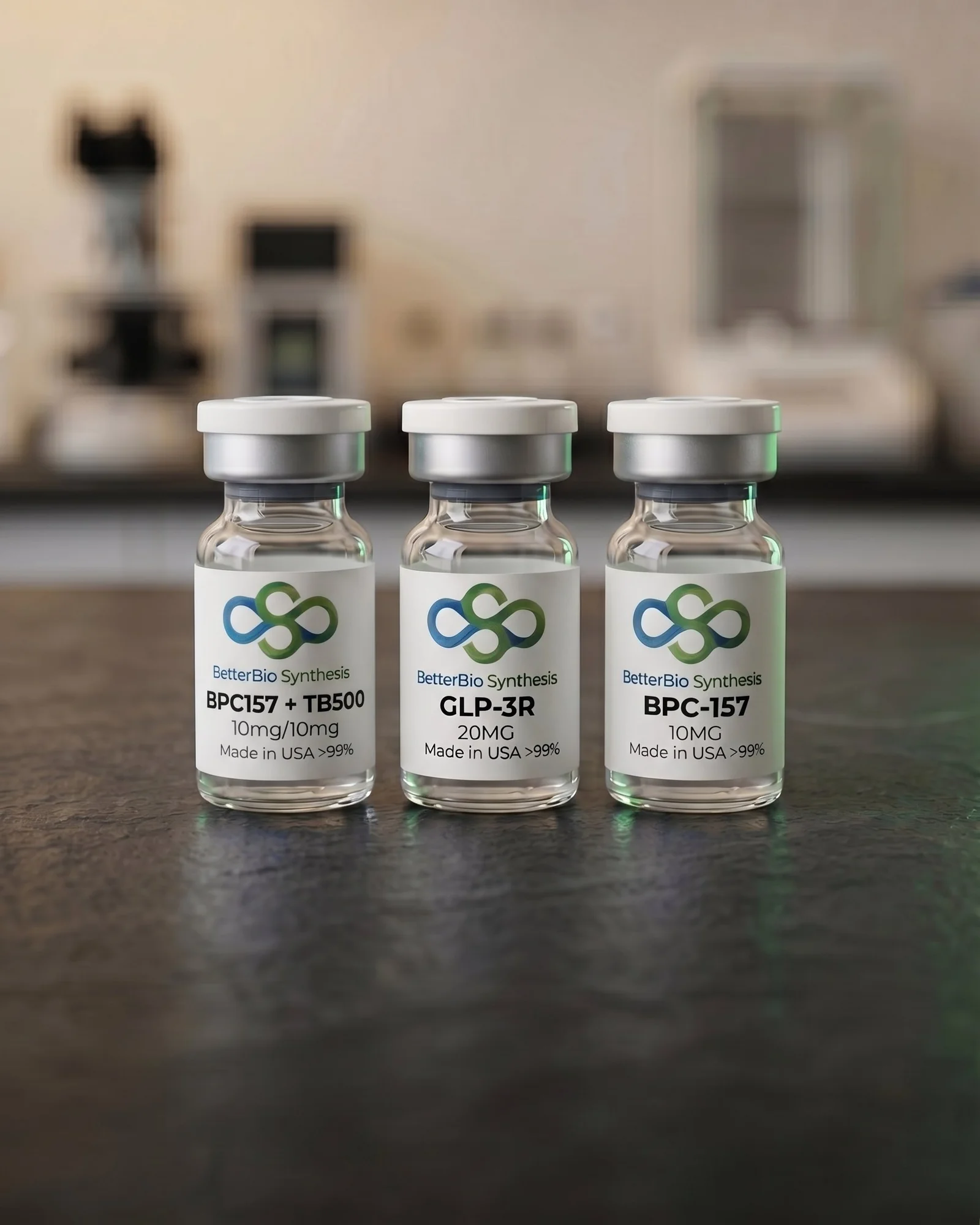
A clear vial is not a complete quality test, and a cloudy one is not automatically a full explanation. Peptide aggregation and solubility depend on sequence, concentration, solvent conditions, handling history, and analytical method choice.
Peptide Quality
Solubility
COA Literacy
A clear vial is not a complete quality test, and a cloudy one is not automatically a full explanation.
Research Use Only
BetterBio Synthesis materials are sold for Research Use Only (RUO). They are not intended for human consumption, clinical use, diagnosis, treatment, prevention, or cure of any disease. This article is educational content about peptide aggregation, solubility, particulate appearance, and research-material quality. It is not medical advice, dosing guidance, administration guidance, treatment guidance, or a recommendation for human use. Not evaluated by the FDA. Must be 21+.
Quick Read: Clarity Is Not the Whole Story
A visually clear peptide solution may still contain impurities, degradation products, small aggregates, or concentration errors that are invisible to the eye.
Cloudiness, visible particles, gel-like material, or precipitate can signal a physical compatibility issue, but appearance alone does not identify the cause.
Peptide quality is often discussed through numbers: purity percentage, molecular weight confirmation, endotoxin result, residual solvent result, fill amount, and batch number. Those numbers matter. A batch-specific Certificate of Analysis can tell researchers whether a material met defined analytical specifications at the time it was tested.
But peptides are not just numbers on a page. They are molecules with physical behavior. Some dissolve easily. Some resist dissolution. Some interact with container surfaces. Some form reversible clusters under one condition and stubborn precipitates under another.
What Aggregation Means in Peptide Research
Aggregation occurs when peptide molecules associate with each other instead of remaining evenly dispersed as individual molecules. The result may be small oligomers, larger soluble aggregates, visible particles, fibers, gels, or precipitated material.
Not all aggregation looks the same. Some aggregates are reversible when conditions change. Others become more persistent over time. Some are driven mainly by hydrophobic interactions, electrostatic shielding, salt concentration, pH, oxidation, disulfide behavior, adsorption to surfaces, or nucleation at interfaces.
Aggregation is also different from chemical degradation, although the two can interact. A peptide can chemically degrade and also form higher-order assemblies. In real samples, both processes may occur together.
Why Some Peptides Are Harder to Dissolve
Peptide solubility is heavily sequence-dependent. A short, highly polar peptide may dissolve easily in one system. A longer or more hydrophobic peptide may resist wetting, cling to surfaces, form clumps, or require a different research-compatible solvent strategy.
Charge distribution matters. Peptides with strong net charge may behave differently as pH changes because ionizable groups gain or lose charge. Around certain pH regions, electrostatic repulsion may decrease, making self-association more likely.
Concentration can shift behavior. A sample that appears manageable at one concentration may become cloudy or viscous at a higher concentration. That means physical compatibility is part of experimental design.
Visible Particles Are a Signal, Not a Diagnosis
Visible particles, cloudiness, haze, flakes, strands, or precipitate should be documented. They can reflect peptide aggregation, incomplete dissolution, container interaction, environmental contamination, crystallization of salts or buffers, microbial contamination, degraded material, or foreign particulate matter.
The key point is that visible appearance does not identify the particle. Researchers need context: batch documentation, storage history, reconstitution conditions, solvent or buffer composition, time since preparation, temperature exposure, agitation, and whether the observation was present before or after handling.
Why COAs Do Not Replace Handling Records
A strong COA helps answer whether a batch met defined specifications when tested. It may include HPLC purity, mass confirmation, endotoxin testing, residual solvent data, appearance, and other lot-specific information.
However, a COA cannot prove that every later sample preparation remained physically stable under every condition. It cannot know whether a vial was warmed repeatedly, opened in humid air, exposed to light, shaken aggressively, reconstituted in a mismatched solvent system, left in solution too long, or subjected to repeated freeze-thaw cycles.
Analytical Methods See Different Things
Reversed-phase HPLC is widely used for peptide purity because it separates species by interactions with the stationary phase under a defined gradient. It is useful, but it is not automatically a complete aggregation assay.
Size-exclusion chromatography can help evaluate size-related species, including aggregates, when the method is suitable for the peptide and sample matrix. But SEC also has limitations: column interactions, dilution effects, method resolution, and sample preparation can affect what is observed.
Mass spectrometry helps confirm molecular identity and can detect certain modifications, but it does not replace physical stability testing by itself. Visual inspection is useful for obvious appearance issues, but it cannot measure subvisible particles or confirm molecular composition.
Common Factors That Influence Aggregation
Temperature, moisture, pH, ionic strength, concentration, agitation, interfaces, and freeze-thaw cycles can all change peptide behavior in research samples.
None of these variables should be turned into universal advice for every peptide. The important point is that physical behavior is conditional. The same material may behave differently when concentration, solvent system, storage history, or container surface changes.
What Researchers Should Record
Record the batch number and COA date. Record the storage condition before preparation. Record the solvent or buffer system, concentration, date prepared, and container type.
Note whether the sample was clear, hazy, cloudy, gel-like, particulate, or precipitated. Record any filtration, centrifugation, temperature exposure, light exposure, agitation, and freeze-thaw events. If a sample changes appearance over time, record when the change occurred.
Bottom Line
Peptide aggregation and solubility are not side details. They are part of research-material quality.
For Research Use Only materials, the most responsible approach is to treat peptide quality as a chain of evidence: batch testing, storage discipline, preparation conditions, physical observations, and fit-for-purpose analytical review. Clear is not always complete. Cloudy is not always fully explained. The strongest research workflow documents both.