Selank vs Semax: What the Research Shows
Selank vs Semax: sequence, origin, Russian clinical studies, FDA 2026 compounding status and WADA, compared side by side with references.

By BetterBio Research Team
Selank and Semax are often mentioned together. Both are short synthetic peptides developed in Russia, both have seven amino acids, and both end in the same three residues. Beyond that, they are different molecules with different origins, research literatures and regulatory histories. This article compares them one point at a time. It covers identity, mechanism studies, animal work, the small human literature and US regulatory status as of November 2026. Claims are linked to the papers and official documents we reviewed. Much of this literature is in Russian, and in several cases we could read only the English abstract; we say so where it matters.
Key takeaways
- Selank (TKPRPGP, about 751.9 g/mol) is a tuftsin analog. Semax (MEHFPGP, about 813.9 g/mol) is a synthetic analog of an ACTH fragment [R12][R11][R1].
- Both are registered medicines in Russia. Neither is approved by the FDA [R13][R11].
- Selank research centers on anxiety-related and immune models. Semax research centers on stroke and neuroprotection models [R1].
- Human data for both are small and mostly published in Russian. FDA reviewed the Semax clinical data in 2026 and found them inadequate [R11].
- Their US status now differs. Semax is covered by HHS’s October 2026 interim compounding policy. Selank is not; FDA lists it among withdrawn nominations it flagged for possible safety risks [R15][R14].
At a glance
| Property | Selank | Semax |
|---|---|---|
| Sequence | Thr-Lys-Pro-Arg-Pro-Gly-Pro (TKPRPGP) | Met-Glu-His-Phe-Pro-Gly-Pro (MEHFPGP) |
| Molecular formula (free base) | C33H57N11O9 | C37H51N9O10S |
| Molecular weight (free base) | 751.9 g/mol | 813.9 g/mol |
| CAS number (free base) | 129954-34-3 | 80714-61-0 |
| FDA UNII (free base) | TS9JR8EP1G | I5FAL2585H |
| Parent peptide | Tuftsin | ACTH fragment |
| Main research focus | Anxiety-related and immune models | Stroke and neuroprotection models |
| Russian registration | Registered (anxiolytic) | Registered |
| FDA approval | None | None |
| Sources | [R12][R13][R1] | [R11][R1] |
Both peptides are also sold as acetate salts, which weigh more than the free base. For Selank, the diacetate is about 872.0 g/mol [R12]; for Semax acetate, FDA lists 874.0 g/mol [R11]. This is one reason a COA should state the salt form.
Two origins, one shared tail
A 2013 review by the Moscow group that worked on both peptides describes Selank as built on tuftsin, a natural immune-modulating peptide, and Semax as a synthetic analog of an ACTH fragment. The same review describes natural regulatory peptides as very unstable, because enzymes in blood and tissue break them down quickly. It presents the synthetic analogs as longer-lived versions [R1].
Both sequences end in Pro-Gly-Pro. A tritium-labeling study tracked how each peptide breaks down. Selank’s main fragments in blood plasma and brain tissue were TKP, TKPRP, RP and GP. Semax broke down in nerve cells to HFPGP and PGP [R6]. So in a biological model, short fragments may be present alongside the intact peptide.
Mechanism research
Selank: GABA-related and enkephalin studies
In radioligand binding work on brain membranes, Selank acted as a positive allosteric modulator of [3H]GABA binding and could block the binding effects of diazepam and olanzapine [R3]. In rat frontal cortex, 45 of 84 neurotransmission-related genes changed significantly after GABA or Selank, and the changes after the two were positively correlated [R4]. For a longer review of this work, see our Selank research overview.
Shared target: enkephalin-degrading enzymes
One area where the two peptides were studied side by side is enkephalin breakdown. A 2001 study from the same group reported that both Semax and Selank inhibit enkephalin-degrading enzymes in human serum, tested in the lab rather than in people [R7]. The tritium study also reported that Semax inhibits plasma enkephalinases through an effect on aminopeptidases [R6]. Enkephalins are natural opioid peptides, so this is a proposed mechanism, not a confirmed one.
Semax: neuroprotection focus
The Moscow review describes Semax mainly as a neuroprotective agent studied in stroke [R1]. In its 2026 evaluation, FDA reviewed Semax for three proposed uses: cerebral ischemia, migraine and trigeminal neuralgia [R11].
Animal research
Most Selank animal work uses stress and anxiety models. One study compared Selank with ten other tuftsin-family peptides in rats and in C57BL/6 and BALB/c mice under conflict-induced stress, and reported anti-stress behavioral effects [R2]. In rats exposed to unpredictable chronic mild stress, Selank combined with diazepam gave elevated plus maze values that did not differ from pre-stress values. The authors called the combination the most effective of the conditions tested [R5]. The English abstract does not give group sizes.
Human studies
Published human work on both peptides is small, comes almost entirely from Russian groups and appears mainly in Russian-language journals. We could read only the English abstracts.
Selank
In a 2008 comparative study, 62 patients with generalized anxiety disorder or neurasthenia received either Selank (30 patients) or the benzodiazepine medazepam (32 patients). The authors reported similar anti-anxiety effects on standard rating scales for both groups. They also measured how quickly serum broke down leu-enkephalin and linked that measure to symptom severity [R8]. The abstract does not describe blinding or randomization.
A 2015 study compared phenazepam alone (30 patients) with phenazepam plus Selank (40 patients) in anxiety-spectrum disorders. The authors reported fewer phenazepam side effects in the combination group, both during treatment and after withdrawal [R9]. Again, the abstract does not describe blinding, and the groups differed in size.
An independent US review in 2021 described Selank as poorly studied and argued that new agents acting on GABA systems should be assessed for abuse potential before they reach the public [R10].
Semax
FDA reviewed the Semax clinical literature for its 2026 compounding evaluation, covering the proposed uses of cerebral ischemia, migraine and trigeminal neuralgia. FDA found the data inadequate to support those uses [R11]. For more detail, see our post on Semax evidence and its limits.
Summary of key studies
| Study | Peptide | Model | Main finding | Ref |
|---|---|---|---|---|
| Kost 2001 | Both | Human serum, in vitro | Both inhibited enkephalin-degrading enzymes | [R7] |
| Kozlovskaya 2003 | Selank | Rats and mice, stress models | Anti-stress behavioral effects reported | [R2] |
| Zolotarev 2006 | Both | Tritium-labeled peptides, plasma and brain | Breakdown fragments identified for each peptide | [R6] |
| Zozulya 2008 | Selank | Humans, n=62, vs medazepam | Similar anti-anxiety scores; blinding not described | [R8] |
| Medvedev 2015 | Selank | Humans, n=70, add-on to phenazepam | Fewer phenazepam side effects reported | [R9] |
| Volkova 2016 | Selank | Rat frontal cortex | Gene-expression changes correlated with GABA | [R4] |
| Kasian 2017 | Selank | Rats, chronic mild stress | Selank plus diazepam most effective condition tested | [R5] |
| Vyunova 2018 | Selank | Brain membranes, binding assays | Positive modulation of GABA binding | [R3] |
| FDA 2026 | Semax | Review of clinical literature | Data inadequate for proposed uses | [R11] |
What the research doesn’t show
- No large, independent, controlled trials. The human studies are small, and their English abstracts do not describe blinding or placebo controls [R8][R9].
- Heavy reliance on one research network. Most papers on both peptides come from a small number of Moscow institutes and share authors [R1][R7][R9]. Independent replication outside Russia is limited [R10].
- Language and access gaps. Much of the literature is in Russian, and several papers have no full English text.
- No head-to-head comparison of outcomes. Apart from in-vitro enzyme work, the two peptides have not been tested against each other [R7].
- Animal results do not transfer automatically. Rodent stress models do not show what happens in people.
Regulatory status (November 2026)
- FDA: Neither peptide is an FDA-approved drug.
- Selank: FDA lists “Selank acetate (TP-7)” among compounding nominations that were withdrawn, and flags a possible immunogenicity risk and missing human safety data [R14]. Selank is not covered by the October 2026 HHS interim compounding policy [R15].
- Semax: Semax was in FDA’s Category 2 from September 29, 2023 to April 22, 2026. FDA staff recommended against adding it to the 503A Bulks List. HHS’s October 2026 interim enforcement-discretion policy covers 503A compounding with Semax under set conditions, pending a final rule. It is not a drug approval and does not cover research-use-only material [R11][R15]. See our post on the October 2026 HHS compounding policy.
- Russia: Both peptides are registered medicines in Russia [R1][R13].
- WADA: The 2026 Prohibited List does not name either peptide. Class S0 covers substances with no approval from any government health authority; because both are registered in Russia, whether S0 applies is unclear. Athletes should confirm with their anti-doping organization [R16].
Reference compound
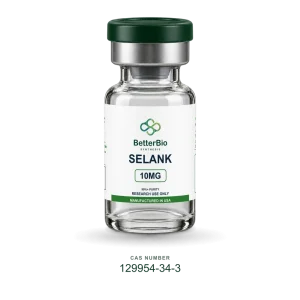
Researchers who need characterized material can find identity data, batch COA details and specifications on our Selank 10mg product page. Semax is also available as Semax 10mg.
References
- Kolomin T, Shadrina M, Slominsky P, Limborska S, Myasoedov N. A new generation of drugs: synthetic peptides based on natural regulatory peptides. Neurosci Med. 2013;4(4):223-252. DOI: 10.4236/nm.2013.44035. No PMID.
- Kozlovskaya MM, Kozlovskii II, Val’dman EA, Seredenin SB. Selank and short peptides of the tuftsin family in the regulation of adaptive behavior in stress. Neurosci Behav Physiol. 2003;33(9):853-860. DOI: 10.1023/a:1025988519919. PMID: 14969422.
- Vyunova TV, Andreeva L, Shevchenko K, Myasoedov NF. Peptide-based anxiolytics: the molecular aspects of heptapeptide Selank biological activity. Protein Pept Lett. 2018;25(10):914-923. DOI: 10.2174/0929866525666180925144642. PMID: 30255741.
- Volkova A, Shadrina M, Kolomin T, Andreeva L, Limborska S, Myasoedov N, Slominsky P. Selank administration affects the expression of some genes involved in GABAergic neurotransmission. Front Pharmacol. 2016;7:31. DOI: 10.3389/fphar.2016.00031. PMID: 26924987.
- Kasian A, Kolomin T, Andreeva L, Bondarenko E, Myasoedov N, Slominsky P, Shadrina M. Peptide Selank enhances the effect of diazepam in reducing anxiety in unpredictable chronic mild stress conditions in rats. Behav Neurol. 2017;2017:5091027. DOI: 10.1155/2017/5091027. PMID: 28280289.
- Zolotarev YuA, Dadaian AK, Dolotov OV, Kozik VS, Kost NV, Sokolov OYu, et al. Evenly tritium-labeled peptides and their in vivo and in vitro biodegradation. Russ J Bioorg Chem. 2006;32(2):166-173. DOI: 10.1134/S1068162006020099. PMID: 16637290.
- Kost NV, Sokolov OYu, Gabaeva MV, Grivennikov IA, Andreeva LA, Myasoedov NF, Zozulya AA. Semax and Selank inhibit the enkephalin-degrading enzymes of human serum. Russ J Bioorg Chem. 2001;27(3):156-159. DOI: 10.1023/a:1011373002885. PMID: 11443939.
- Zozulia AA, Neznamov GG, Siuniakov TS, Kost NV, Gabaeva MV, Sokolov OIu, et al. Efficacy and possible mechanisms of action of a new peptide anxiolytic selank in the therapy of generalized anxiety disorders and neurasthenia. Zh Nevrol Psikhiatr Im S S Korsakova. 2008;108(4):38-48 (in Russian). No DOI. PMID: 18454096.
- Medvedev VE, Tereshchenko ON, Kost NV, Ter-Israelyan AYu, Gushanskaya EV, Chobanu IK, et al. Optimization of the treatment of anxiety disorders with selank. Zh Nevrol Psikhiatr Im S S Korsakova. 2015;115(6):33-40 (in Russian). DOI: 10.17116/jnevro20151156133-40. PMID: 26356395.
- Doyno CR, White CM. Sedative-hypnotic agents that impact gamma-aminobutyric acid receptors: focus on flunitrazepam, gamma-hydroxybutyric acid, phenibut, and selank. J Clin Pharmacol. 2021;61(Suppl 2):S114-S128. DOI: 10.1002/jcph.1922. PMID: 34396551.
- U.S. Food and Drug Administration. FDA Briefing Document: Semax related bulk drug substances. Pharmacy Compounding Advisory Committee meeting, July 2026 (briefing document dated May 11, 2026). https://www.fda.gov/media/193348/download (regulatory document; no DOI or PMID).
- U.S. Food and Drug Administration / NCATS. Global Substance Registration System record: Selank, UNII TS9JR8EP1G. https://drugs.ncats.io/substance/TS9JR8EP1G (database record; no DOI or PMID).
- Vidal Russia drug reference. Selank, registration certificate LP-№(010951)-(RG-RU). https://www.vidal.ru/drugs/selank__21568 (drug reference entry, in Russian; no DOI or PMID).
- U.S. Food and Drug Administration. Certain Bulk Drug Substances for Use in Compounding that May Present Significant Safety Risks (content current as of April 22, 2026). https://www.fda.gov/drugs/human-drug-compounding/certain-bulk-drug-substances-use-compounding-may-present-significant-safety-risks (regulatory web page; no DOI or PMID).
- U.S. Department of Health and Human Services. HHS Enforcement Discretion Policy Regarding 503A Compounding Using Certain Peptide Bulk Drug Substances (Appendix B). October 2026. https://www.hhs.gov/sites/default/files/hhs-503a-peptide-enforcement-discretion-policy-appendix-b.pdf (regulatory document; no DOI or PMID).
- World Anti-Doping Agency. The 2026 Prohibited List (in effect January 1, 2026), class S0 Non-Approved Substances. https://www.wada-ama.org/sites/default/files/2025-09/2026list_en_final_clean_september_2025.pdf (regulatory document; no DOI or PMID).
Research use only
This article summarizes published research for informational and laboratory-research purposes only. It is not medical advice. Selank and Semax sold by BetterBio Synthesis are for laboratory research use only. They are not for human or veterinary use and are not intended to diagnose, treat, cure or prevent any disease.