CJC-1295 With DAC vs Without DAC: What the Research Shows
CJC-1295 with DAC and without DAC are different molecules. A referenced look at the studies, the ipamorelin data, and 2026 FDA and WADA status.
By BetterBio Research Team
“CJC-1295” is used online for two different molecules. One carries a drug-affinity complex (DAC) that binds albumin in blood. The other does not. They have different masses, different half-lives and different evidence behind them. This review sets out what each published study actually used, adds what is known about ipamorelin, the secretagogue often paired with it, and records the regulatory position as of November 2026. Every claim links to the paper or official document we read.
Key takeaways
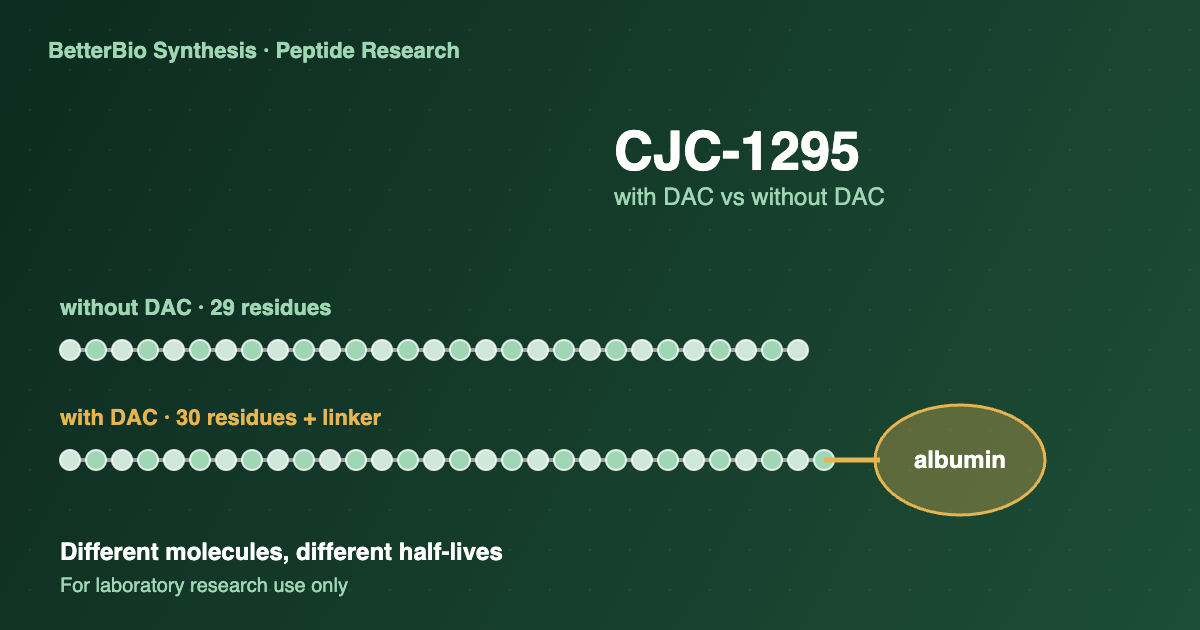
- CJC-1295, as registered by FDA, is a 30-residue peptide: a four-times-substituted human GRF(1-29) with a C-terminal lysine whose side chain carries a maleimide group that reacts with albumin [R1][R10].
- “CJC-1295 without DAC” keeps the four substitutions but drops that lysine-maleimide group. It is the 29-residue peptide also called modified GRF (1-29), with a calculated mass of about 3367.9 g/mol against the registry’s estimated 3500 g/mol for the DAC form [R10].
- The human CJC-1295 data come from the DAC form. A single subcutaneous dose raised mean plasma GH 2- to 10-fold for 6 days or more and IGF-I 1.5- to 3-fold for 9 to 11 days, with an estimated half-life of 5.8 to 8.1 days [R3].
- Ipamorelin works through a different receptor. GHRH antagonists did not block it, and its in-vitro EC50 in rat pituitary cells was 1.3 ± 0.4 nmol/L [R2]. In human volunteers its terminal half-life was about 2 hours [R6].
- We found no published study of a CJC-1295 plus ipamorelin blend, and no human trial of the without-DAC form.
- Neither compound is FDA-approved. Both are named in class S2 of WADA’s 2026 Prohibited List, prohibited at all times [R15].

What the DAC actually is
The 2005 paper that named CJC-1295 tested three maleimido derivatives of human GH-releasing factor hGRF(1-29). The maleimide group reacts with the free cysteine-34 thiol on serum albumin, which produces a long-lived conjugate. The authors conjugated the peptides to albumin outside the body, measured GH release from cultured rat anterior pituitary cells, and found all three more stable than hGRF(1-29) against dipeptidyl peptidase-IV [R1]. In normal male rats, the best compound, CJC-1295, produced about a 4-fold larger 2-hour GH area under the curve than hGRF(1-29), and albumin-associated material was still in plasma beyond 72 hours [R1].
FDA’s substance registry records the same structure: a 30-residue chain, D-alanine at position 2, and a C-terminal lysine whose Nε carries a 3-maleimidopropionamide group, CAS 446262-90-4, UNII 62RC32V9N7 [R10]. The sequence in that record also shows the four changes from human GRF(1-29): D-Ala at 2, Gln at 8, Ala at 15 and Leu at 27 [R10].
Remove the lysine-maleimide group and the albumin link described in that paper is gone. The remaining 29-residue peptide is what sellers label “without DAC” or “modified GRF (1-29)”. It has no separate FDA registry entry, no UNII and no confirmed CAS number, which is why identity should be read from a batch mass spectrum rather than from a product name.
The human CJC-1295 studies used the DAC form
Two randomised, placebo-controlled, double-blind ascending-dose trials, lasting 28 and 49 days, enrolled healthy subjects aged 21 to 61 [R3]. After a single subcutaneous injection, mean plasma GH rose 2- to 10-fold in a dose-dependent way for 6 days or more, and mean plasma IGF-I rose 1.5- to 3-fold for 9 to 11 days. The estimated half-life of CJC-1295 was 5.8 to 8.1 days, and after repeat doses mean IGF-I stayed above baseline for up to 28 days. No serious adverse reactions were reported [R3].
A second study asked whether that continuous stimulation flattens the normal GH rhythm. Healthy men were sampled every 20 minutes across a 12-hour overnight window, before and one week after a single injection. Trough GH rose about 7.5-fold and mean GH about 46%, while pulse frequency and pulse size were unchanged [R5]. So the GH increase came mainly from a higher baseline, not from bigger pulses.
In GHRH knockout mice, once-daily CJC-1295 maintained normal body weight, length and composition over 5 weeks at 2 µg per injection, and the same dose given every 48 or 72 hours was less effective [R4].
None of these studies used material without the DAC group. Reading the 5.8 to 8.1 day half-life across to a without-DAC peptide is not supported: that figure describes a molecule designed to ride on albumin.
Where the GHRH analogs differ
Three related molecules are often confused:
- Sermorelin is hGRF(1-29) itself, the unmodified 29-residue fragment, sequence YADAIFTNSYRKVLGQLSARKLLQDIMSR [R16]. It is the starting point the CJC work substituted.
- CJC-1295 without DAC is that fragment with four substitutions and no albumin linker.
- Tesamorelin is a longer, 44-residue GRF analog [R17] and is the only one of the three with an FDA-approved drug product, approved November 10, 2010 as EGRIFTA [R18]. Approval of that product says nothing about research-grade material sold under any of these names.
What is known about ipamorelin
Ipamorelin is a pentapeptide, Aib-His-D-2-Nal-D-Phe-Lys-NH2, with two non-standard residues, formula C38H49N9O5 and mass 711.85 g/mol [R11]. The 1998 paper that introduced it reported an EC50 of 1.3 ± 0.4 nmol/L in rat pituitary cells against 2.2 ± 0.3 nmol/L for GHRP-6, and ED50 values of 80 ± 42 nmol/kg in anaesthetised rats and 2.3 ± 0.03 nmol/kg in conscious swine. GHRH antagonists did not block its effect, which pointed to a GHRP-type receptor. It did not raise ACTH or cortisol above the levels seen with GHRH stimulation even at doses more than 200-fold above those needed for GH release, and it did not change FSH, LH, prolactin or TSH [R2].
In human volunteers, a dose-escalation study with 15-minute infusions at five dose levels and eight healthy men per level found dose-proportional kinetics, a terminal half-life of about 2 hours, clearance of 0.078 L/h/kg and a steady-state volume of 0.22 L/kg. GH release came as a single episode peaking around 0.67 hours, with a half-maximal stimulating concentration of 214 nmol/L [R6].
Animal bone work exists as well. A rat study reported longitudinal bone growth [R7]. In 13-week-old female rats treated for 12 weeks by subcutaneous minipump, ipamorelin at 0.5 mg/kg/day raised total bone mineral content against vehicle, but content corrected for body weight was unchanged and volumetric bone density did not rise [R8].
The one randomised clinical trial we found tested a different question. In a phase 2, double-blind, placebo-controlled study (NCT00672074) of 117 patients after bowel resection, 114 in the analysis populations, intravenous ipamorelin at 0.03 mg/kg twice daily gave a median time to tolerating a solid meal of 25.3 hours against 32.6 hours for placebo, which was not statistically significant (p = 0.15). Treatment-emergent adverse events occurred in 87.5% of the ipamorelin group and 94.8% of the placebo group [R9]. The trial missed its primary endpoint.
FDA has separately stated, on its bulk-substances page, that it has identified serious adverse events, including death, in a published report of intravenous ipamorelin use for gastric motility, and serious adverse events for CJC-1295 including increased heart rate and a systemic vasodilatory reaction [R12].
Summary of key studies
| Study | Model | What was measured | Main finding | Ref |
|---|---|---|---|---|
| Jetté 2005 | Rat pituitary cells; male Sprague-Dawley rats | DPP-IV stability, GH release, plasma persistence | CJC-1295 identified as albumin-binding, long-lasting GRF analog; ~4-fold larger 2-h GH AUC than hGRF(1-29) | R1 |
| Raun 1998 | Rat pituitary cells; rats; conscious swine | EC50/ED50, receptor pathway, other hormones | EC50 1.3 nmol/L; not blocked by GHRH antagonists; no change in FSH, LH, PRL, TSH | R2 |
| Teichman 2006 | Humans, healthy, randomised, placebo-controlled | GH and IGF-I, pharmacokinetics | GH up 2-10x for ≥6 d; IGF-I up 1.5-3x for 9-11 d; half-life 5.8-8.1 d (DAC form) | R3 |
| Alba 2006 | GHRH knockout mice, 5 weeks | Growth, body composition, pituitary GH mRNA | Once-daily 2 µg kept growth normal; every 48-72 h less effective | R4 |
| Ionescu 2006 | Humans, healthy men, overnight sampling | GH pulsatility, IGF-I | Trough GH +7.5x, mean GH +46%; pulse frequency and size unchanged | R5 |
| Gobburu 1999 | Humans, 5 dose levels, 8 men per level | Ipamorelin PK/PD | Half-life ~2 h; clearance 0.078 L/h/kg; EC50 214 nmol/L | R6 |
| Johansen 1999 | Rats | Longitudinal bone growth | Ipamorelin induced longitudinal bone growth | R7 |
| Svensson 2000 | Female rats, 12 weeks, minipump | DXA and pQCT bone measures | Total BMC up vs. vehicle; BMC corrected for body weight unchanged | R8 |
| Beck 2014 | Humans, phase 2 RCT, n=117 | Time to tolerating solid meal | 25.3 h vs 32.6 h placebo, p = 0.15; endpoint not met | R9 |
What the research doesn’t show
- No study of the blend. We found no published work on a CJC-1295 plus ipamorelin mixture. A study that needs to attribute an effect to one pathway needs single-component arms, for example a separate Ipamorelin 10mg control.
- No human data on the without-DAC form. Every human CJC-1295 result cited here used the albumin-binding version [R3][R5].
- No long-term safety data for either compound. The trials above ran for days to weeks, and the one ipamorelin trial ran to postoperative day 7 [R9].
- Hormone measures are not outcomes. A rise in GH or IGF-I is a biochemical reading. None of these studies measured body composition, injury repair or performance outcomes.
- Identity gaps for the without-DAC material. No UNII, no registry entry and no confirmed CAS number means the label alone does not establish what is in a vial.
Regulatory status (November 2026)
- FDA: Neither CJC-1295 nor ipamorelin is an approved drug. Ipamorelin acetate sits in Category 2 of FDA’s interim 503B policy, added September 29, 2023, with concerns over immunogenicity, aggregation, peptide impurities and characterisation, and a published report of serious adverse events including death after intravenous use. CJC-1295 appears in the table of substances nominated and then withdrawn on the same page, with FDA-identified serious adverse events noted. That page was current as of April 22, 2026 [R12].
- HHS interim policy: On October 30, 2026, HHS published an interim enforcement-discretion policy for 503A compounding with certain peptide bulk drug substances, docket HHS-OASH-2026-0496, 91 Fed. Reg. 68526 [R13]. Appendix A names six substances only: BPC-157, Epitalon, KPV, MOTS-c, Semax and TB-500 [R14]. CJC-1295 and ipamorelin are not covered. The notice states that compounded drugs are not FDA-approved [R13], and the policy describes itself as aimed partly at discouraging continued use of research-use-only peptides from foreign manufacturers [R14].
- WADA: The 2026 Prohibited List, effective January 1, 2026, lists CJC-1295 under GHRH and its analogues and ipamorelin under growth hormone secretagogues, in class S2, prohibited in and out of competition [R15].
Reference compound
Researchers who need characterised material can find identity data, batch COA fields and specifications on our CJC-1295 without DAC 5mg + Ipamorelin 5mg blend page.
References
- Jetté L, Léger R, Thibaudeau K, Benquet C, Robitaille M, Pellerin I, et al. Human growth hormone-releasing factor (hGRF)1-29-albumin bioconjugates activate the GRF receptor on the anterior pituitary in rats: identification of CJC-1295 as a long-lasting GRF analog. Endocrinology. 2005;146(7):3052-3058. DOI: 10.1210/en.2004-1286. PMID: 15817669.
- Raun K, Hansen BS, Johansen NL, Thøgersen H, Madsen K, Ankersen M, Andersen PH. Ipamorelin, the first selective growth hormone secretagogue. Eur J Endocrinol. 1998;139(5):552-561. DOI: 10.1530/eje.0.1390552. PMID: 9849822.
- Teichman SL, Neale A, Lawrence B, Gagnon C, Castaigne JP, Frohman LA. Prolonged stimulation of growth hormone (GH) and insulin-like growth factor I secretion by CJC-1295, a long-acting analog of GH-releasing hormone, in healthy adults. J Clin Endocrinol Metab. 2006;91(3):799-805. DOI: 10.1210/jc.2005-1536. PMID: 16352683.
- Alba M, Fintini D, Sagazio A, Lawrence B, Castaigne JP, Frohman LA, Salvatori R. Once-daily administration of CJC-1295, a long-acting growth hormone-releasing hormone (GHRH) analog, normalizes growth in the GHRH knockout mouse. Am J Physiol Endocrinol Metab. 2006;291(6):E1290-E1294. DOI: 10.1152/ajpendo.00201.2006. PMID: 16822960.
- Ionescu M, Frohman LA. Pulsatile secretion of growth hormone (GH) persists during continuous stimulation by CJC-1295, a long-acting GH-releasing hormone analog. J Clin Endocrinol Metab. 2006;91(12):4792-4797. DOI: 10.1210/jc.2006-1702. PMID: 17018654.
- Gobburu JV, Agersø H, Jusko WJ, Ynddal L. Pharmacokinetic-pharmacodynamic modeling of ipamorelin, a growth hormone releasing peptide, in human volunteers. Pharm Res. 1999;16(9):1412-1416. DOI: 10.1023/a:1018955126402. PMID: 10496658.
- Johansen PB, Nowak J, Skjærbæk C, Flyvbjerg A, Andreassen TT, Wilken M, Ørskov H. Ipamorelin, a new growth-hormone-releasing peptide, induces longitudinal bone growth in rats. Growth Horm IGF Res. 1999;9(2):106-113. DOI: 10.1054/ghir.1999.9998. PMID: 10373343.
- Svensson J, Lall S, Dickson SL, Bengtsson BÅ, Rømer J, Ahnfelt-Rønne I, et al. The GH secretagogues ipamorelin and GH-releasing peptide-6 increase bone mineral content in adult female rats. J Endocrinol. 2000;165(3):569-577. DOI: 10.1677/joe.0.1650569. PMID: 10828840.
- Beck DE, Sweeney WB, McCarter MD; Ipamorelin 201 Study Group. Prospective, randomized, controlled, proof-of-concept study of the Ghrelin mimetic ipamorelin for the management of postoperative ileus in bowel resection patients. Int J Colorectal Dis. 2014;29(12):1527-1534. DOI: 10.1007/s00384-014-2030-8. PMID: 25331030.
- U.S. Food and Drug Administration, Global Substance Registration System. Substance record: CJC-1295, UNII 62RC32V9N7 (CAS 446262-90-4). https://gsrs.ncats.nih.gov/ginas/app/beta/substances/62RC32V9N7 (registry record; no DOI or PMID).
- U.S. Food and Drug Administration, Global Substance Registration System. Substance record: Ipamorelin, UNII Y9M3S784Z6 (CAS 170851-70-4; C38H49N9O5; 711.85). https://gsrs.ncats.nih.gov/ginas/app/beta/substances/Y9M3S784Z6 (registry record; no DOI or PMID).
- U.S. Food and Drug Administration. Certain bulk drug substances for use in compounding that may present significant safety risks. Content current as of April 22, 2026. https://www.fda.gov/drugs/human-drug-compounding/certain-bulk-drug-substances-use-compounding-may-present-significant-safety-risks (regulatory document; no DOI or PMID).
- U.S. Department of Health and Human Services. Enforcement discretion policy regarding 503A compounding using certain peptide bulk drug substances. 91 Fed. Reg. 68526 (October 30, 2026); Docket No. HHS-OASH-2026-0496. https://www.govinfo.gov/content/pkg/FR-2026-10-30/html/2026-22192.htm (regulatory document; no DOI or PMID).
- U.S. Department of Health and Human Services. HHS enforcement discretion policy regarding 503A compounding using certain peptide bulk drug substances (Appendices A and B). October 2026. https://www.hhs.gov/sites/default/files/hhs-503a-peptide-enforcement-discretion-policy-appendix-b.pdf (regulatory document; no DOI or PMID).
- World Anti-Doping Agency. The 2026 Prohibited List (in effect January 1, 2026), class S2 Peptide Hormones, Growth Factors, Related Substances and Mimetics. https://www.wada-ama.org/sites/default/files/2025-09/2026list_en_final_clean_september_2025.pdf (regulatory document; no DOI or PMID).
- U.S. Food and Drug Administration, Global Substance Registration System. Substance record: Sermorelin, UNII 89243S03TE (29-residue sequence YADAIFTNSYRKVLGQLSARKLLQDIMSR). https://gsrs.ncats.nih.gov/ginas/app/beta/substances/89243S03TE (registry record; no DOI or PMID).
- U.S. Food and Drug Administration, Global Substance Registration System. Substance record: Tesamorelin, UNII MQG94M5EEO (44-residue GRF analog). https://gsrs.ncats.nih.gov/ginas/app/beta/substances/MQG94M5EEO (registry record; no DOI or PMID).
- U.S. Food and Drug Administration. Drugs@FDA: EGRIFTA (tesamorelin acetate), BLA 022505, original approval November 10, 2010. https://www.accessdata.fda.gov/scripts/cder/daf/index.cfm?event=overview.process&ApplNo=022505 (regulatory document; no DOI or PMID).
Research use only
This article summarizes published research for informational and laboratory-research purposes only. It is not medical advice. CJC-1295 without DAC and ipamorelin sold by BetterBio Synthesis are for laboratory research use only. They are not for human or veterinary use and are not intended to diagnose, treat, cure or prevent any disease.