
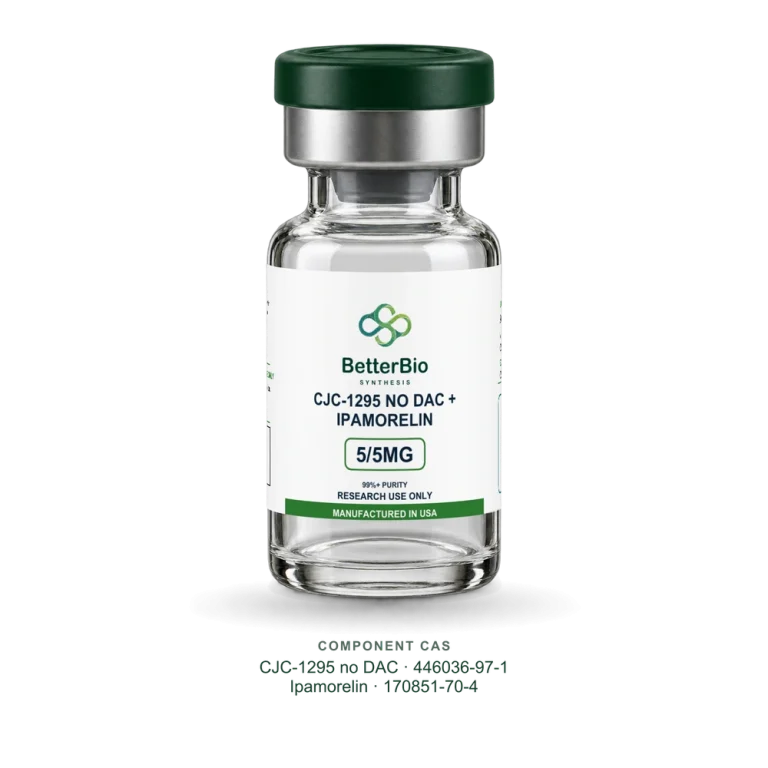
CJC-1295 5mg without DAC + Ipamorelin 5mg
This vial holds two separate research peptides: 5 mg of CJC-1295 without DAC and 5 mg of ipamorelin. The two amounts describe ingredient masses, not one molecule, so the vial contains 10 mg of peptide in total.For research use only. Not for human or veterinary use.
Research use only. Create an account to see ordering options.
Sign in or create an accountResearch use only. Must be 21 or older to purchase.● In stock · 82 available
Final prices and availability are confirmed in your cart. View cart →
SKU: BBS-CJCIPA-5-5
Product details
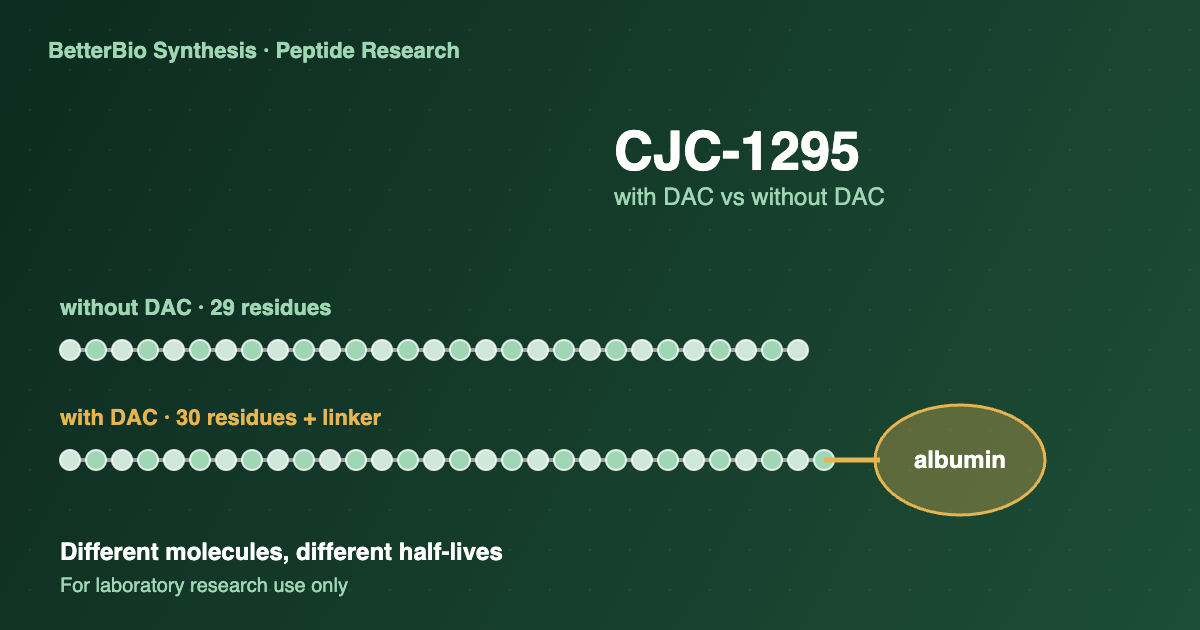
This vial holds two separate research peptides: 5 mg of CJC-1295 without DAC and 5 mg of ipamorelin. The two amounts describe ingredient masses, not one molecule, so the vial contains 10 mg of peptide in total.
The two components come from different chemical families. CJC-1295 without DAC is a four-times-substituted version of human growth hormone-releasing factor 1-29, the fragment also known as modified GRF (1-29) [R1][R10]. Ipamorelin is a five-residue peptide that acts at a growth hormone secretagogue receptor rather than at the GHRH receptor [R2][R11].
The word "DAC" matters. The named compound CJC-1295 in the FDA substance registry carries a 30th residue, a lysine whose side chain holds a maleimide group, and that group binds to albumin in plasma. That is the drug-affinity complex, or DAC [R1][R10]. The material in this vial has no DAC, so papers on the albumin-binding form describe a different molecule with a different mass and a different half-life [R3].
No published study tests this two-peptide combination. Work on either component alone does not describe the mixture. A study design that uses this vial needs single-component controls and a defined endpoint.
Identity & specifications
| Property | CJC-1295 without DAC | Ipamorelin |
|---|---|---|
| Name | CJC-1295 without DAC | Ipamorelin (INN) |
| Synonyms | CJC-1295 no DAC; modified GRF (1-29); mod GRF 1-29; [D-Ala2, Gln8, Ala15, Leu27]-hGRF(1-29)-NH2; CJC-1295 DAC-free | Ipamorelin; NNC 26-0161; Aib-His-D-2-Nal-D-Phe-Lys-NH2 [R11] |
| CAS number | No CAS number is recorded for the without-DAC form in the FDA substance registry (the DAC-bearing parent, CJC-1295, is CAS 446262-90-4) [R10] | 170851-70-4 [R11] |
| Molecular formula | C152H252N44O42 (calculated from the verified 29-residue sequence with a C-terminal amide; not listed as a separate registry entry) | C38H49N9O5 [R11] |
| Molecular weight | About 3367.9 g/mol (calculated average mass, free base) | 711.85 g/mol [R11] |
| Sequence (1-letter) | Y-(D-Ala)-DAIFTQSYRKVLAQLSARKLLQDILSR-NH2 (29 residues; D-alanine at position 2) [R10] | Aib-His-D-2-Nal-D-Phe-Lys-NH2 (5 residues) [R2][R11] |
| Substitutions vs. parent | Four changes from human GRF(1-29): D-Ala at position 2, Gln at 8, Ala at 15, Leu at 27 [R1][R10] | Contains two non-standard residues: 2-aminoisobutyric acid (Aib) and 2-naphthylalanine [R11] |
| FDA UNII | No UNII for the without-DAC form; the DAC-bearing parent CJC-1295 is 62RC32V9N7 [R10] | Y9M3S784Z6 [R11] |
| PubChem CID | — | 9831659 [R11] |
| Amount per vial | 5 mg | 5 mg |
| Blend ratio | 1:1 by mass (5 mg : 5 mg; 10 mg total peptide). The molar ratio is about 1 part CJC-1295 without DAC to 4.7 parts ipamorelin, because the two molecular weights differ (calculated from the masses above) | |
| Form | Lyophilized (freeze-dried) powder, both components in one vial | |
| Storage | Store the sealed, lyophilized vial cold and dry, protected from light; −20 °C for long-term storage | |
Research overview
The GHRH-receptor component
The paper that named CJC-1295 described a four-times-substituted human GRF(1-29) peptide carrying a lysine with a maleimide group at the C-terminus. That group reacts with the free thiol on serum albumin, which makes the conjugate long-lived in plasma [R1]. The substitutions were made to resist dipeptidyl peptidase-IV, and the authors measured growth hormone release from cultured rat anterior pituitary cells [R1].
Material sold as "CJC-1295 without DAC" keeps the four substitutions but not the lysine-maleimide group, so the albumin link described in that paper does not apply to it.
The secretagogue component
Ipamorelin was described in 1998 as a pentapeptide that releases growth hormone through a GHRP-type receptor, not through the GHRH receptor. The authors reported that GHRH antagonists did not block its action, and called it a selective growth hormone secretagogue [R2]. It was studied in rat pituitary cells, in anaesthetised rats and in conscious swine [R2].
Animal models
Ipamorelin has been studied in rat bone models. One study reported longitudinal bone growth in rats [R7]. A 12-week study in female rats reported higher total bone mineral content than vehicle controls, with no change once the figures were corrected for body weight [R8].
For the GHRH-analog side, a study in GHRH knockout mice compared once-daily, every-48-hour and every-72-hour schedules of CJC-1295 (the DAC-bearing form) [R4].
Human pharmacology of the single components
Both components have been given to human volunteers in published pharmacology studies: CJC-1295 with DAC in two ascending-dose trials [R3][R5], and ipamorelin in a dose-escalation pharmacokinetic study [R6] and a later phase 2 surgical trial [R9]. Neither compound is an approved drug, and those studies used single components, not a blend.
Limits of the evidence
- No study tests this combination. We found no published study of a CJC-1295 plus ipamorelin blend. Any result from this vial cannot be assigned to either component.
- The DAC form and the without-DAC form are not interchangeable. The human trials of CJC-1295 used the albumin-binding form [R3][R5]. Mass, half-life and duration differ for material without the DAC group.
- Identity data for the without-DAC form are thin. There is no separate FDA registry entry, UNII or confirmed CAS number for it. The formula and mass above are calculated from the sequence, so they should be checked against the batch mass spectrum.
- Ipamorelin's clinical record is limited. The one randomised trial we found did not meet its primary endpoint [R9].
- Animal results do not transfer to people. Rat and swine findings describe those models only.
Regulatory status (as of November 2026)
- Not FDA-approved drugs. Neither CJC-1295 (in any form) nor ipamorelin has FDA approval for any use.
- FDA compounding lists: Ipamorelin acetate sits in Category 2 of FDA's interim 503B policy, added September 29, 2023, with immunogenicity, aggregation, impurity and characterisation concerns noted, and a published report of serious adverse events including death after intravenous use for gastric motility [R12]. CJC-1295 appears on the same FDA page in the table of substances nominated and then withdrawn, where FDA states it has identified serious adverse events associated with CJC-1295, including increased heart rate and a systemic vasodilatory reaction [R12]. That page was current as of April 22, 2026.
- HHS interim policy (October 30, 2026): HHS published an interim enforcement-discretion policy for 503A compounding with certain peptide bulk drug substances [R13]. Its Appendix A names six substances: BPC-157, Epitalon, KPV, MOTS-c, Semax and TB-500 [R14]. Neither CJC-1295 nor ipamorelin is named. The policy also states that compounded drugs are not FDA-approved [R13], and it does not cover research-use-only material [R14].
- WADA: The 2026 Prohibited List, in effect January 1, 2026, names CJC-1295 among GHRH analogues and ipamorelin among growth hormone secretagogues, both in class S2, prohibited at all times [R15].
Read the full research review: CJC-1295 With DAC vs Without DAC: What the Research Shows
FAQ
What is in this vial?
Two peptides: 5 mg of CJC-1295 without DAC and 5 mg of ipamorelin, freeze-dried together. That is 10 mg of peptide in total, in a 1:1 mass ratio.
What does "without DAC" mean?
DAC stands for drug-affinity complex. In the compound registered as CJC-1295, a lysine side chain carries a maleimide group that binds to albumin in plasma [R1][R10]. Material without DAC lacks that group, so it is a 29-residue peptide with a lower mass.
Is CJC-1295 without DAC the same as modified GRF (1-29)?
Those names describe the same four-times-substituted GRF(1-29) sequence. Because there is no registry entry for the without-DAC form, confirm the identity from the batch COA rather than from the name on the label.
What are the molecular weights?
Ipamorelin is 711.85 g/mol with the formula C38H49N9O5 [R11]. For CJC-1295 without DAC, the calculated average mass is about 3367.9 g/mol (C152H252N44O42). The DAC-bearing parent is heavier; the FDA registry lists an estimated 3500 g/mol for it [R10].
Are there studies on the blend itself?
We found none. Published work covers each component alone, and the human CJC-1295 trials used the DAC-bearing form [R3][R5].
How is purity verified for a two-component vial?
The COA should report HPLC purity for each component and confirm both masses by mass spectrometry, so the ratio and both identities are documented. Check the lot number on the vial against the COA, and prefer an independent third-party lab.
How does this differ from the single-peptide listings?
The store also lists Ipamorelin 10mg as a single component. A single-peptide vial lets a study isolate one pathway; a blend does not.
Is either peptide FDA approved?
No. Neither is an approved drug. Ipamorelin acetate is in Category 2 of FDA's interim 503B policy, CJC-1295 is listed on the same FDA page as nominated and withdrawn with serious adverse events noted [R12], and both are on WADA's 2026 Prohibited List [R15].
References
- Jetté L, Léger R, Thibaudeau K, Benquet C, Robitaille M, Pellerin I, et al. Human growth hormone-releasing factor (hGRF)1-29-albumin bioconjugates activate the GRF receptor on the anterior pituitary in rats: identification of CJC-1295 as a long-lasting GRF analog. Endocrinology. 2005;146(7):3052-3058. DOI: 10.1210/en.2004-1286. PMID: 15817669.
- Raun K, Hansen BS, Johansen NL, Thøgersen H, Madsen K, Ankersen M, Andersen PH. Ipamorelin, the first selective growth hormone secretagogue. Eur J Endocrinol. 1998;139(5):552-561. DOI: 10.1530/eje.0.1390552. PMID: 9849822.
- Teichman SL, Neale A, Lawrence B, Gagnon C, Castaigne JP, Frohman LA. Prolonged stimulation of growth hormone (GH) and insulin-like growth factor I secretion by CJC-1295, a long-acting analog of GH-releasing hormone, in healthy adults. J Clin Endocrinol Metab. 2006;91(3):799-805. DOI: 10.1210/jc.2005-1536. PMID: 16352683.
- Alba M, Fintini D, Sagazio A, Lawrence B, Castaigne JP, Frohman LA, Salvatori R. Once-daily administration of CJC-1295, a long-acting growth hormone-releasing hormone (GHRH) analog, normalizes growth in the GHRH knockout mouse. Am J Physiol Endocrinol Metab. 2006;291(6):E1290-E1294. DOI: 10.1152/ajpendo.00201.2006. PMID: 16822960.
- Ionescu M, Frohman LA. Pulsatile secretion of growth hormone (GH) persists during continuous stimulation by CJC-1295, a long-acting GH-releasing hormone analog. J Clin Endocrinol Metab. 2006;91(12):4792-4797. DOI: 10.1210/jc.2006-1702. PMID: 17018654.
- Gobburu JV, Agersø H, Jusko WJ, Ynddal L. Pharmacokinetic-pharmacodynamic modeling of ipamorelin, a growth hormone releasing peptide, in human volunteers. Pharm Res. 1999;16(9):1412-1416. DOI: 10.1023/a:1018955126402. PMID: 10496658.
- Johansen PB, Nowak J, Skjærbæk C, Flyvbjerg A, Andreassen TT, Wilken M, Ørskov H. Ipamorelin, a new growth-hormone-releasing peptide, induces longitudinal bone growth in rats. Growth Horm IGF Res. 1999;9(2):106-113. DOI: 10.1054/ghir.1999.9998. PMID: 10373343.
- Svensson J, Lall S, Dickson SL, Bengtsson BÅ, Rømer J, Ahnfelt-Rønne I, et al. The GH secretagogues ipamorelin and GH-releasing peptide-6 increase bone mineral content in adult female rats. J Endocrinol. 2000;165(3):569-577. DOI: 10.1677/joe.0.1650569. PMID: 10828840.
- Beck DE, Sweeney WB, McCarter MD; Ipamorelin 201 Study Group. Prospective, randomized, controlled, proof-of-concept study of the Ghrelin mimetic ipamorelin for the management of postoperative ileus in bowel resection patients. Int J Colorectal Dis. 2014;29(12):1527-1534. DOI: 10.1007/s00384-014-2030-8. PMID: 25331030.
- U.S. Food and Drug Administration, Global Substance Registration System. Substance record: CJC-1295, UNII 62RC32V9N7 (CAS 446262-90-4; 30-residue sequence with Nε-maleimidopropionamide lysine). https://gsrs.ncats.nih.gov/ginas/app/beta/substances/62RC32V9N7 (registry record; no DOI or PMID).
- U.S. Food and Drug Administration, Global Substance Registration System. Substance record: Ipamorelin, UNII Y9M3S784Z6 (CAS 170851-70-4; C38H49N9O5; 711.85). https://gsrs.ncats.nih.gov/ginas/app/beta/substances/Y9M3S784Z6 (registry record; no DOI or PMID).
- U.S. Food and Drug Administration. Certain bulk drug substances for use in compounding that may present significant safety risks. Content current as of April 22, 2026. https://www.fda.gov/drugs/human-drug-compounding/certain-bulk-drug-substances-use-compounding-may-present-significant-safety-risks (regulatory document; no DOI or PMID).
- U.S. Department of Health and Human Services. Enforcement discretion policy regarding 503A compounding using certain peptide bulk drug substances. 91 Fed. Reg. 68526 (October 30, 2026); Docket No. HHS-OASH-2026-0496. https://www.govinfo.gov/content/pkg/FR-2026-10-30/html/2026-22192.htm (regulatory document; no DOI or PMID).
- U.S. Department of Health and Human Services. HHS enforcement discretion policy regarding 503A compounding using certain peptide bulk drug substances (Appendices A and B). October 2026. https://www.hhs.gov/sites/default/files/hhs-503a-peptide-enforcement-discretion-policy-appendix-b.pdf (regulatory document; no DOI or PMID).
- World Anti-Doping Agency. The 2026 Prohibited List (in effect January 1, 2026), class S2 Peptide Hormones, Growth Factors, Related Substances and Mimetics. https://www.wada-ama.org/sites/default/files/2025-09/2026list_en_final_clean_september_2025.pdf (regulatory document; no DOI or PMID).
Research use only
This product is sold strictly for laboratory research use only. It is not a drug, food, dietary supplement or cosmetic. It is not intended to diagnose, treat, cure or prevent any disease, and it is not for human or veterinary use. BetterBio Synthesis makes no claims about safety or effectiveness in humans or animals. Buyers are responsible for handling this material in line with all applicable laws and institutional rules.
Purity & COA
Match this lot to the number on your vial before using its report.
- Listed lot
- 202605CP10
- Test date
- September 3, 2026
- Reported purity
- 99.91%
- Laboratory
- Hyte Research - Freedom Testing
Explore more research materials
 Tesamorelin 10mg with Ipamorelin 2mg Blend
 Tesamorelin 10mg with Ipamorelin 5mg Blend
 3x GH Blend: Tesamorelin 5mg | Ipamorelin 2.5mg | MGF 0.5mg
 Ipamorelin 10mg
Common questions
How do I find the right COA?
Match the lot printed on your product to a record in the COA Library. The listed batch is linked above.
Where can I check shipping and payment details?
See the current shipping policy and payment policy before ordering.

