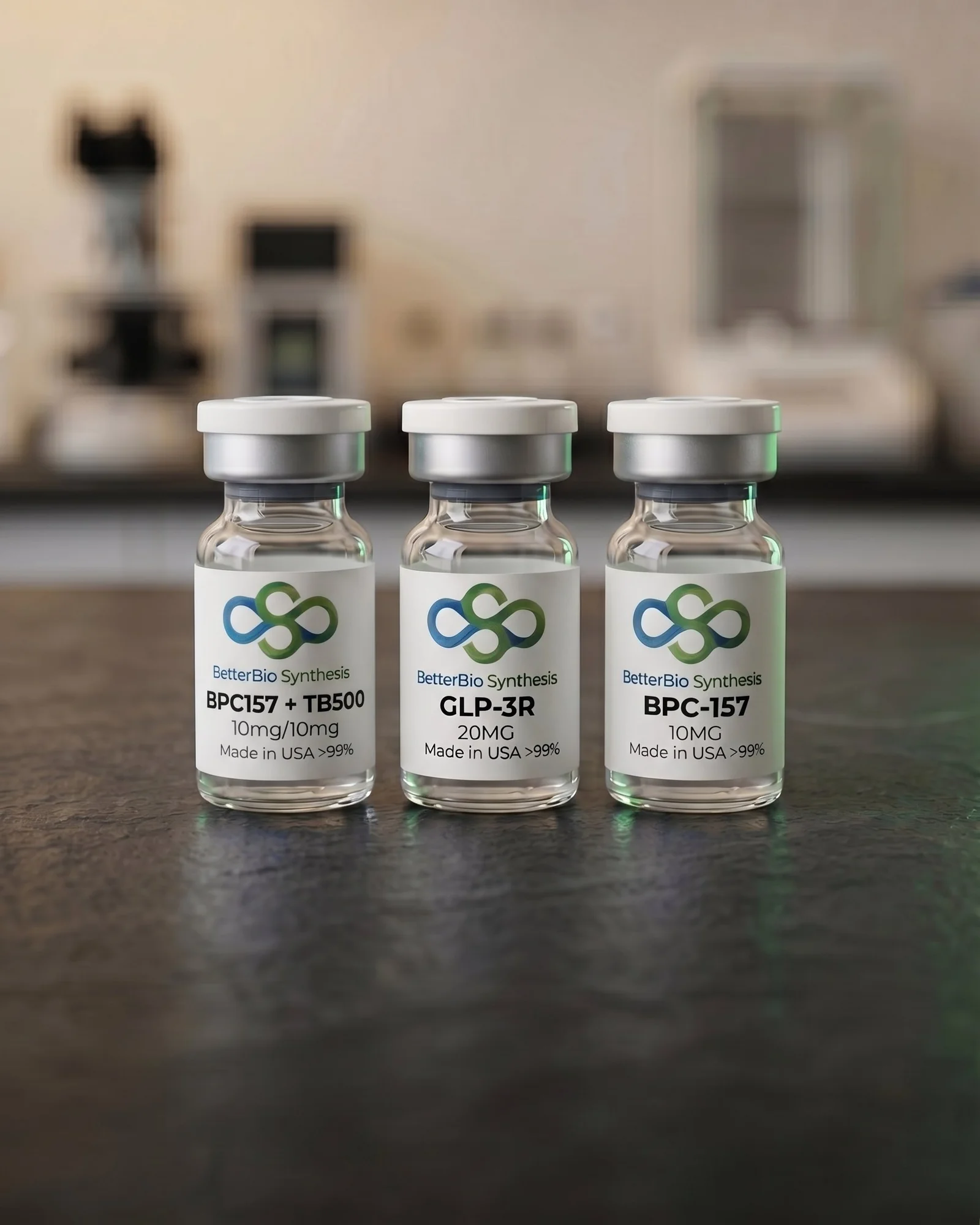
Extractables and Leachables in Peptide Vial Systems: Why Packaging Belongs in Quality Review
Learn why extractables, leachables, vial stoppers, and container-closure compatibility belong beside purity, identity, and COA review in RUO peptide research.

Testing Literacy
Extractables and Leachables in Peptide Vial Systems
A peptide vial is not just storage. Glass, stoppers, liners, and handling conditions can influence the sample history behind the data.
A peptide vial is easy to treat as a neutral object. The label carries the compound name, the cap protects the closure, the glass holds the material, and the COA describes the tested batch. In everyday research language, the vial can disappear into the background.
Quality review is stronger when it does not disappear.
Every research material has a contact history. Before a peptide reaches an assay, it may contact synthesis and purification surfaces, filtration components, lyophilization equipment, vial glass, rubber or elastomeric closure material, cap liners, shipping materials, storage environments, solvents, diluents, pipette tips, and analytical containers. Most of these surfaces are routine and controlled. They still matter because analytical chemistry is often sensitive enough to see trace-level events that the eye cannot.
That is the basic reason extractables and leachables belong in research-quality literacy. A COA may focus on identity, purity, mass confirmation, endotoxin, residual solvents, or appearance. Those are important starting points. But container-closure compatibility asks a related question: what can the packaging system contribute to, remove from, or change about the material over time?
This is not a dosing topic, a use recommendation, or a medical claim. It is a research documentation topic. For RUO peptide workflows, understanding the vial system helps researchers interpret analytical data with better context.
What Extractables and Leachables Mean
Extractables are chemical species that can be pulled out of a packaging material or contact surface under intentionally stressed laboratory conditions. Those conditions may involve aggressive solvents, elevated temperature, extended time, or other exaggerated study designs. The goal is to build a broad picture of what a material could release if pushed.
Leachables are chemical species that actually migrate into a product, sample, solvent, or formulation under realistic storage or handling conditions. In other words, extractables describe potential. Leachables describe observed migration in the relevant system.
That distinction matters. A rubber stopper, liner, plastic component, adhesive, ink, lubricant, or processing aid may have an extractables profile. Only some of those potential migrants may appear as leachables under the conditions that matter for a specific vial, solvent, peptide, temperature, concentration, and time period. A strong assessment does not assume every possible extractable becomes a real sample impurity. It asks which ones are plausible, detectable, and relevant.
For peptide research, the same logic applies even when a lab is not preparing a regulatory submission. The practical question is whether the vial system is compatible with the material and the analytical purpose. If an unexpected chromatographic peak appears, if background interference changes, if apparent recovery drops, or if replicate behavior is inconsistent, contact materials become part of the troubleshooting map.
Why Vial Systems Are More Than Glass
"Glass vial" sounds simple, but the container-closure system is a set of parts. A typical vial system can include the glass container, elastomeric stopper, cap, crimp, liner or coating, label, secondary packaging, desiccant, and shipping configuration. The sample may also contact analytical vials, autosampler inserts, septa, transfer devices, filters, and storage racks during downstream handling.
Each material can have a different chemistry. Borosilicate glass can contribute questions about surface interactions, pH shift, delamination risk, or trace ions depending on conditions. Elastomeric closures can contain curing agents, antioxidants, plasticizers, pigments, processing aids, silicone, fluoropolymer coatings, or other formulation-specific components. Plastics can introduce questions about additives, oligomers, adsorption, or solvent compatibility.
None of that means a vial system is automatically unsuitable. It means the word "vial" should not be treated as a complete quality description. For serious research documentation, the closure, contact surfaces, and storage conditions are part of the material history.
This is especially important for peptides because they can be chemically diverse. Some sequences are charged and hydrophilic. Others are more hydrophobic. Some may be prone to oxidation, deamidation, aggregation, adsorption, or surface loss under particular conditions. A contact surface that is unremarkable for one molecule may be more important for another.
How E&L Can Affect Analytical Interpretation
Extractables and leachables are often discussed as safety and regulatory concerns, but they also have an analytical-quality dimension. A migrant does not have to be present at a dramatic level to create confusion in a sensitive method.
In chromatographic testing, a leachable may appear as an unknown peak, shoulder, baseline feature, or co-eluting interference. In mass spectrometry, it may contribute background ions, suppress signal, complicate identification, or make low-level impurity review harder. In colorimetric or plate-based assays, contact-derived material can sometimes influence matrix behavior. In stability studies, packaging contributions can be mistaken for peptide degradation unless the method and controls are designed carefully.
The reverse problem is also possible: the container may remove something from the sample. Adsorption to glass, plastic, septa, or transfer surfaces can reduce apparent recovery, especially at low concentration or high surface-area exposure. That is not usually called a leachable problem, but it belongs to the same compatibility conversation. The sample is interacting with the system that holds it.
Good controls help separate these possibilities. Blank container extracts, solvent blanks, matrix blanks, stressed packaging studies, orthogonal methods, and time-point comparisons can all help determine whether an unexpected feature comes from the peptide, the solvent, the container, or the analytical workflow.
Why Current Guidance Uses Risk-Based Review
Recent regulatory-style guidance around container closure systems continues to emphasize risk-based assessment. The principle is straightforward: the depth of testing should match the risk created by the drug, material, route, formulation, packaging system, storage condition, and duration of contact.
RUO peptide education should not import regulatory requirements as if they directly define every research-use material. But the scientific logic is useful. A vial system should be evaluated according to the questions it creates. Does it protect the material? Is it chemically compatible? Could it introduce interfering substances? Could storage or shipping conditions alter the contact profile? Are the tests appropriate for the system being studied?
For a dry lyophilized research material, the relevant questions may differ from a liquid formulation. For short-term contact, the risk picture may differ from long-term storage. For a nonpolar solvent, the extractables profile may differ from an aqueous buffer. For a trace-level LC-MS workflow, background compatibility may matter more than it would in a less sensitive assay.
The useful takeaway is not that every lab needs the same test menu. The useful takeaway is that packaging should be reviewed as part of the system, not as an afterthought.
What a Stronger Research Review Can Include
A practical container-closure review starts with traceability. The vial, stopper, cap, liner, storage condition, and lot or supplier details should be known when possible. If the same peptide batch is split into different containers, that should be visible in the record. If a method uses autosampler vials, inserts, septa, filters, or low-binding plastics, those choices should also be documented.
The next layer is compatibility. Researchers can ask whether the solvent or matrix is likely to interact with the container, whether pH or ionic strength could stress the material, whether light or oxygen exposure is relevant, and whether the storage time creates a meaningful contact period. These questions do not need to become overcomplicated, but they should not be invisible.
The third layer is analytical control. If an unknown peak appears, a blank and a container-related control can be more useful than speculation. If recovery is low, surface adsorption and transfer loss should be considered alongside instrument drift or calculation error. If two aliquots from the same batch behave differently, the container and handling record may help explain the difference.
Finally, the review should stay proportional. A research team does not need to overstate risk just because contact materials exist. The point is to make the workflow interpretable. Packaging information is one more way to distinguish a batch-quality question from a sample-history question.
How This Fits Beside the COA
A COA and a container-closure review are complementary. The COA tells the researcher what the tested batch showed under defined methods. Container-closure review asks how the material is housed, protected, and exposed after or during that tested state.
If the COA reports identity and purity, that supports confidence in the starting material. If the vial system and storage record are also clear, the researcher has a stronger chain of evidence. If a later analysis shows a new unknown, lower apparent concentration, or changed impurity pattern, the reviewer can compare the original COA, the handling history, and the container contact history instead of treating all variation as a mystery.
This is where BetterBio's quality-literacy approach matters. Research-grade peptide work is not only about a single number on a label. It is about whether identity, purity, storage, handling, packaging, and analytical controls tell a coherent story.
BetterBio's Research-First View
For research-use peptides, packaging is part of the research record. A vial is not only a container; it is a contact surface, closure system, storage environment, and traceability point.
That does not make every vial a problem. It makes the vial a variable worth documenting.
The strongest approach is simple: keep the COA, lot identity, storage conditions, handling notes, and container information together. When data are clean, that record reinforces confidence. When data are unexpected, it gives the researcher a smarter place to start troubleshooting.
In RUO workflows, that kind of documentation does not make claims about outcomes. It makes the quality conversation more complete.