Glass Transition and Cake Collapse: Why Lyophilized Peptide Structure Matters
Learn how glass transition, collapse temperature, residual moisture, and lyophilized cake structure shape research peptide stability and quality review.
Peptide Stability
Glass Transition and Cake Collapse: Why Lyophilized Peptide Structure Matters
A lyophilized peptide vial is more than dried powder. Glass transition, residual moisture, and cake structure can influence stability, appearance, and reconstitution behavior.
Lyophilized peptides are often described as "freeze-dried," but that phrase can make the process sound simpler than it is. A finished vial is not just a peptide with water removed. It is a dried solid system with its own physical state, residual moisture level, surface area, porosity, glassy matrix behavior, and storage sensitivity.
That matters because peptide stability is not controlled by one variable. Sequence, purity, counterion, residual solvents, water content, temperature, light exposure, container closure, and manufacturing history can all shape what happens after a vial leaves production. Lyophilization is one of the most important tools for improving solid-state stability, but it does not make a material immune to change.
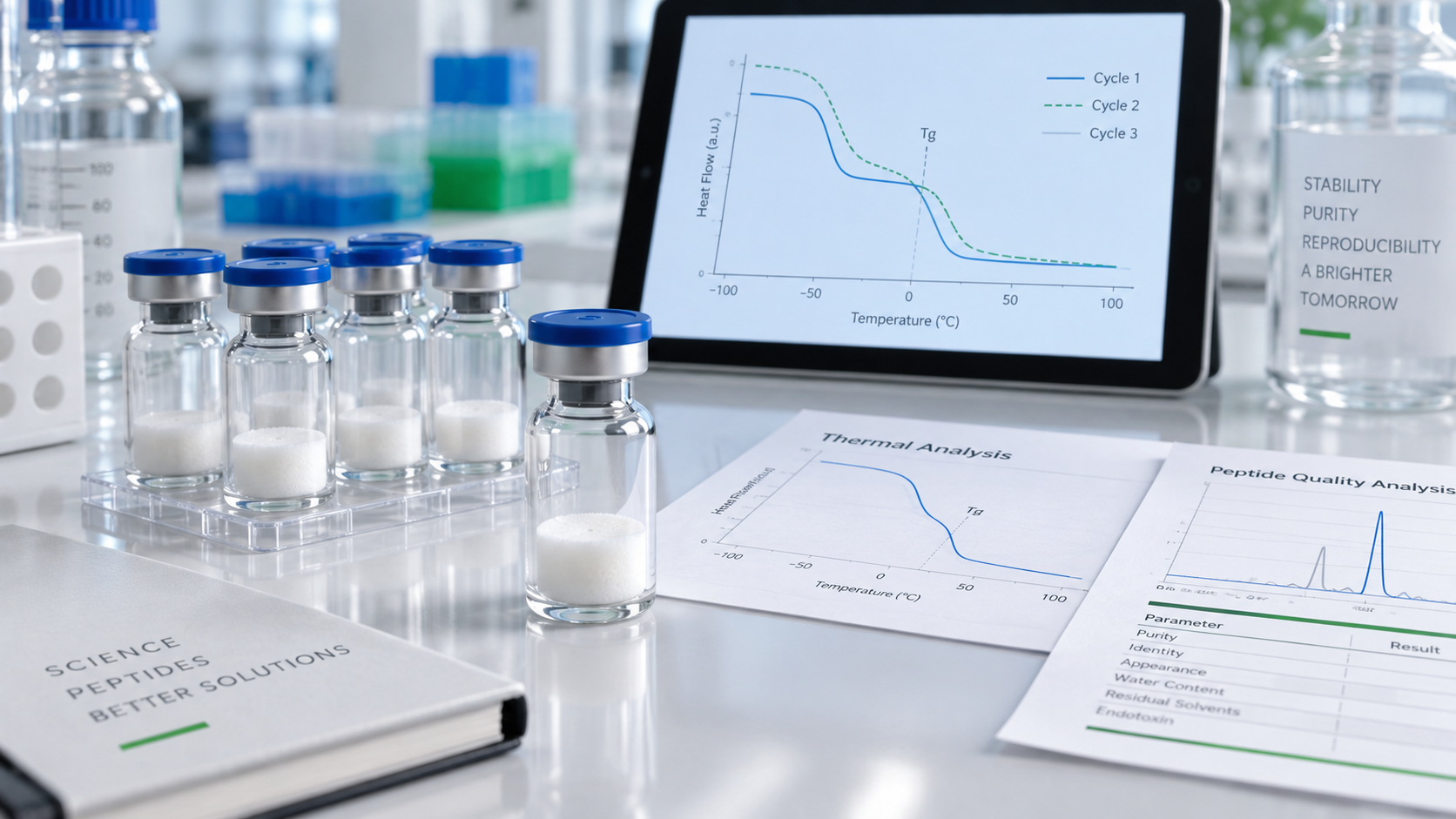
One useful concept is glass transition. In a lyophilized peptide cake, the dried matrix can behave like a glassy solid below a certain temperature range. When temperature or moisture pushes the system beyond that range, molecular mobility can increase. More mobility can mean more opportunity for chemical degradation, physical collapse, aggregation, or slower reconstitution.
What glass transition means
Glass transition is not the same thing as melting. A crystalline material has a relatively sharp melting point. Many lyophilized formulations, by contrast, include amorphous regions that do not melt in the same clean way. Instead, they soften over a temperature range as the molecular structure gains mobility.
Below the glass transition range, the dried matrix is relatively rigid. Peptide molecules, salts, buffers, and excipients are held in a lower-mobility environment. Above it, the matrix becomes more rubbery or mobile. The peptide does not have to visibly melt for stability risk to change; a shift in molecular mobility can be enough.
This is why a vial that looks dry is not automatically in an optimal physical state. The important question is not only whether water was removed. It is whether the remaining solid structure has enough thermal and moisture margin for storage, handling, and shipment conditions.
Why residual moisture matters
Residual moisture is one of the biggest drivers of glass transition behavior in dried peptide systems. Water can act as a plasticizer, meaning it lowers the temperature at which the dried matrix becomes more mobile.
In practical terms, two vials can both appear dry while having different moisture profiles. The vial with more residual water may have less stability margin at the same storage temperature. That does not automatically mean failure, but it does change the quality question.
This is why residual moisture testing is not just a cosmetic detail. It helps explain whether the lyophilized state is likely to remain stable under defined conditions. It also helps researchers interpret differences between lots that look similar at first glance but behave differently during storage or reconstitution.
What cake collapse signals
Cake collapse happens when the dried structure loses its intended form during or after freeze-drying. A collapsed cake may appear shrunken, glassy, dense, foamed, sticky, or pulled away from the vial wall. Sometimes collapse is dramatic; sometimes it is subtle.
Appearance alone cannot prove potency, identity, purity, sterility, or safety. A neat cake can still have analytical problems, and an imperfect-looking cake may still meet certain specifications. But cake appearance is still useful because it can be a visible signal of process history and physical state.
For COA literacy, the key is to avoid both extremes. Do not assume every visual imperfection is catastrophic. Also do not dismiss cake structure as "just looks." In lyophilized systems, appearance often belongs in the same conversation as residual moisture, reconstitution behavior, and storage instructions.
How storage and reconstitution connect
Collapse temperature guides the freeze-drying cycle. Glass transition helps explain solid-state stability after drying. Both concepts remind researchers that lyophilization is temperature-sensitive from production through storage.
Reconstitution behavior is one of the most practical readouts of lyophilized cake quality. A porous, well-structured cake usually wets and dissolves more predictably than a dense or collapsed mass. Slow wetting, clumping, persistent haze, or unusual residue can raise questions about physical state, aggregation, moisture exposure, or formulation compatibility.
Reconstitution observations are not a substitute for analytical testing. They cannot prove molecular identity or purity. But they can provide useful context, especially when compared across lots under the same research conditions.
How COAs and stability notes fit in
A standard peptide COA may include identity, HPLC purity, mass confirmation, residual solvents, water content, endotoxin, sterility, or other lot-specific tests depending on the product and supplier. Not every COA will include glass transition or collapse temperature data, because those are often part of process development rather than routine release testing.
That does not make the topic irrelevant. It means researchers should understand which documents answer which questions. HPLC purity says something about chromatographic related substances under a defined method. LC-MS supports molecular identity. Water content speaks to drying and moisture burden. Stability data speaks to how quality attributes change over time under defined conditions. Appearance speaks to physical state and process consistency.
The strongest review combines these signals instead of forcing one number to answer everything.
Why storage language should be specific
Storage instructions are part of quality communication. "Keep cold" is less useful than a defined condition, a handling window, and a reason. Lyophilized peptide materials are often more stable than comparable solutions, but they can still be sensitive to heat, moisture, oxygen, and light.
For research settings, the safest educational framing is conservative: keep vials sealed until needed, avoid unnecessary warming cycles, protect from light when relevant, and follow lot-specific supplier storage instructions. Once material is reconstituted, the stability profile changes because the peptide is no longer protected by the dried solid matrix.
This distinction is important. A stability assumption for a sealed lyophilized vial should not be automatically transferred to a prepared solution. The physical state has changed, water activity has changed, and degradation pathways may accelerate.
Bottom line
Glass transition gives researchers a better way to think about lyophilized peptide stability. The visible cake is not just a cosmetic feature. Residual moisture is not just a number. Storage temperature is not just a shipping preference. Together, they describe whether a dried peptide system has enough physical stability margin to remain suitable for its intended research context.
A polished peptide quality program should connect vial appearance, residual moisture, stability data, storage instructions, and batch-matched analytical evidence. No single item proves everything, but together they create a clearer picture.
For BetterBio-style education, the practical lesson is simple: treat lyophilized peptide vials as engineered research materials, not generic dry powder. The structure of the dried state is part of the quality story.