
GLP-1 Gallstones and Pancreatitis: Separating Drug Effects From Rapid Weight Loss
GLP-1 gallbladder risk is supported by randomized trials, while pancreatitis evidence is mixed. Learn how drug effects and rapid weight loss overlap.
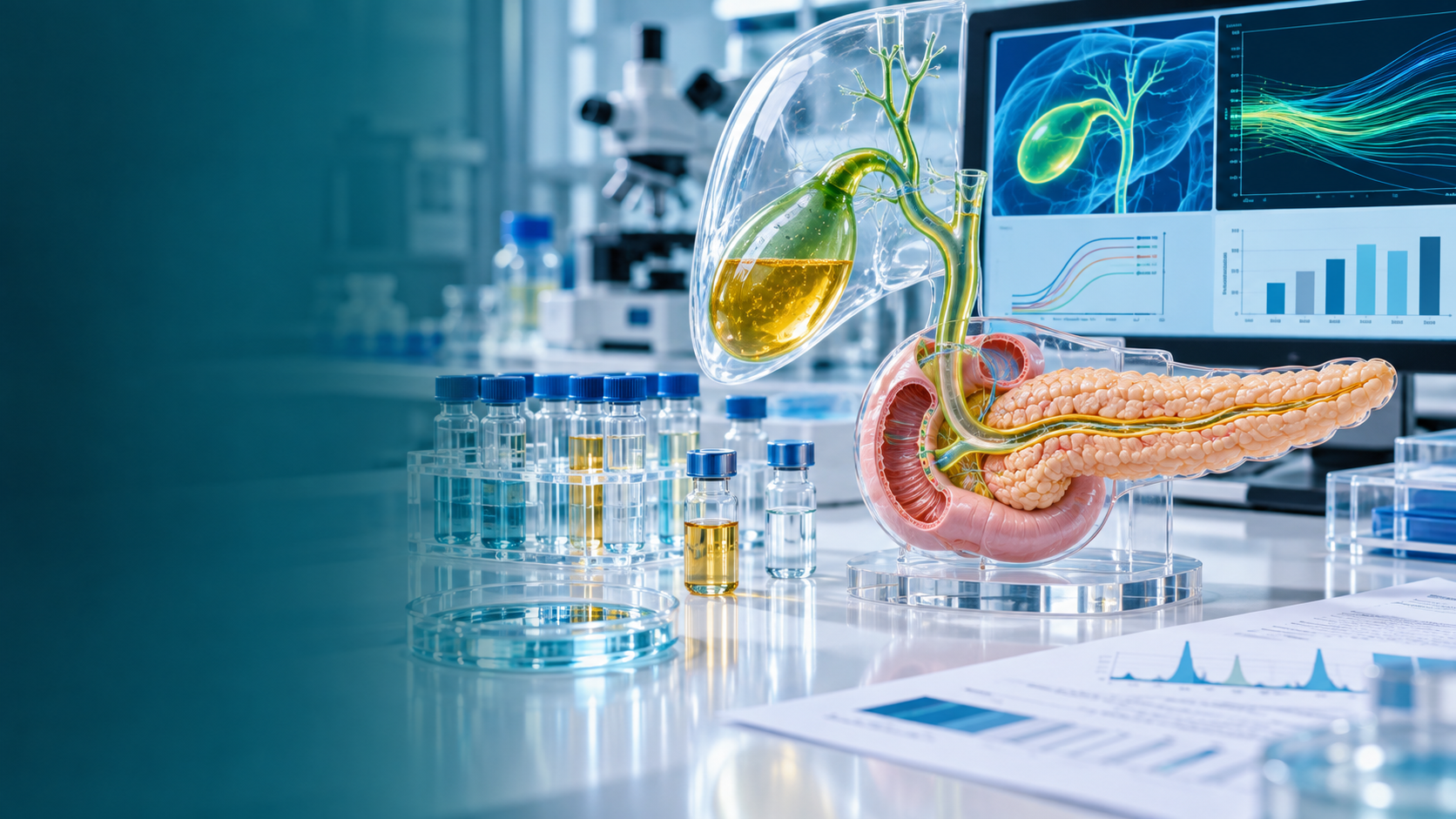
Gallbladder disease and acute pancreatitis are often merged into one GLP-1 safety story. Randomized trials support an increased risk of gallbladder and biliary events. Pancreatitis is rarer, and its evidence varies by design, comparator, cause, and follow-up.
Rapid weight loss complicates both questions. Gallstones were documented during very-low-calorie diets and after bariatric surgery long before modern incretin drugs, while GLP-1 signaling can also affect eating, digestion, and gallbladder emptying.
Two outcomes, not one safety signal
Cholelithiasis means stones in the gallbladder or biliary tract. Cholecystitis is inflammation, often after a stone obstructs bile flow. Broader biliary composites may include several diagnoses and procedures.
Acute pancreatitis is inflammation of the pancreas and has multiple possible causes, including gallstones, alcohol exposure, high triglycerides, medications, and unexplained cases.
A gallstone can trigger pancreatitis by obstructing a shared drainage pathway. That biological connection does not mean that an increase in gallstones automatically proves an increase in pancreatitis.
The randomized gallbladder evidence
A 2022 meta-analysis combined 76 randomized trials and 103,371 participants. GLP-1 assignment was associated with a 37% higher relative risk of gallbladder or biliary disease, including higher relative risks for gallstones, gallbladder inflammation, and biliary disease.
The signal was stronger in weight-loss trials and with higher doses and longer exposure. Those patterns support an association, but dose, duration, and achieved weight loss often move together.
These percentages are relative. Because events remain uncommon, absolute rates and counts are necessary for understanding the scale of the difference.
Why rapid weight loss matters
During substantial weight reduction, more cholesterol can enter bile while lower food and fat intake reduces meal-triggered gallbladder contraction. Cholesterol-rich bile that remains relatively static is more likely to form crystals, sludge, and stones.
Diet and bariatric-surgery research confirms that weight-reduction strategies can increase gallbladder and biliary events. That physiology predates GLP-1 drugs.
Most GLP-1 trials cannot isolate the contribution of weight loss because the drug arm both receives the drug and loses more weight. A clean test would require similar weight-loss magnitude and rate across groups with different drug exposure.
The drug may add its own effect
GLP-1 biology can plausibly affect gallbladder motility and meal-triggered signaling. Reduced food intake also changes the normal frequency of gallbladder contraction.
Semaglutide labeling recognizes both sides: rapid weight loss can increase gallstone risk, yet acute gallbladder disease was more common with the drug than placebo even after accounting for the degree of weight loss.
The useful conclusion is that weight loss does not explain away the signal, while drug exposure is not the only pathway. Agent-level risk may vary with receptor profile, dose, exposure, population, and achieved weight change.
Why pancreatitis remains unsettled
Pancreatitis is rare in randomized metabolic trials, leaving wide confidence intervals. Tirzepatide trial reviews have not shown a clear increase or dose-response, but the small number of cases limits precision.
A 2025 Veterans Health Administration analysis reported acute pancreatitis in 0.31% of GLP-1 users and 0.24% of DPP-4 inhibitor users. A larger 2026 study comparing GLP-1 and sulfonylurea initiation found similar overall rates at one year.
Different comparators, populations, surveillance, and adjustment strategies can produce different answers. A large class-wide increase has not been consistently demonstrated, while small or time-dependent differences remain possible.
Timing and cause change the result
The 2026 target-trial emulation found similar total one-year rates but different cause-specific patterns. Suspected drug-induced events were higher and clustered early, while alcohol-associated and high-triglyceride pancreatitis were lower later.
Biliary and unexplained pancreatitis were similar. Opposing components can therefore produce a neutral overall total.
Cause classification in health records is imperfect. Stronger research should report timing, weight trajectory, triglycerides, gallbladder disease, and adjudicated cause rather than treating every event after exposure as the same mechanism.
The retatrutide evidence gap
Retatrutide activates GIP, GLP-1, and glucagon receptors and remains investigational. Published trials are not large or long enough to estimate rare gallbladder and pancreatic outcomes precisely.
The phase 2 obesity study reported one serious acute-pancreatitis event. One event cannot define incidence or mechanism. Protocols have also excluded people with a pancreatitis history, limiting what trial results can establish for that group.
The magnitude of weight loss makes biliary surveillance important, but it does not prove proportionally greater risk. Agent-specific event tables, adjudication, weight-loss trajectories, and longer follow-up are still needed.
Gallbladder disease is a supported GLP-1 class signal shaped by both weight-loss physiology and drug exposure. Pancreatitis is a separate, rarer, and less settled outcome. For retatrutide, absence of adequate data is not evidence of either safety or harm.

