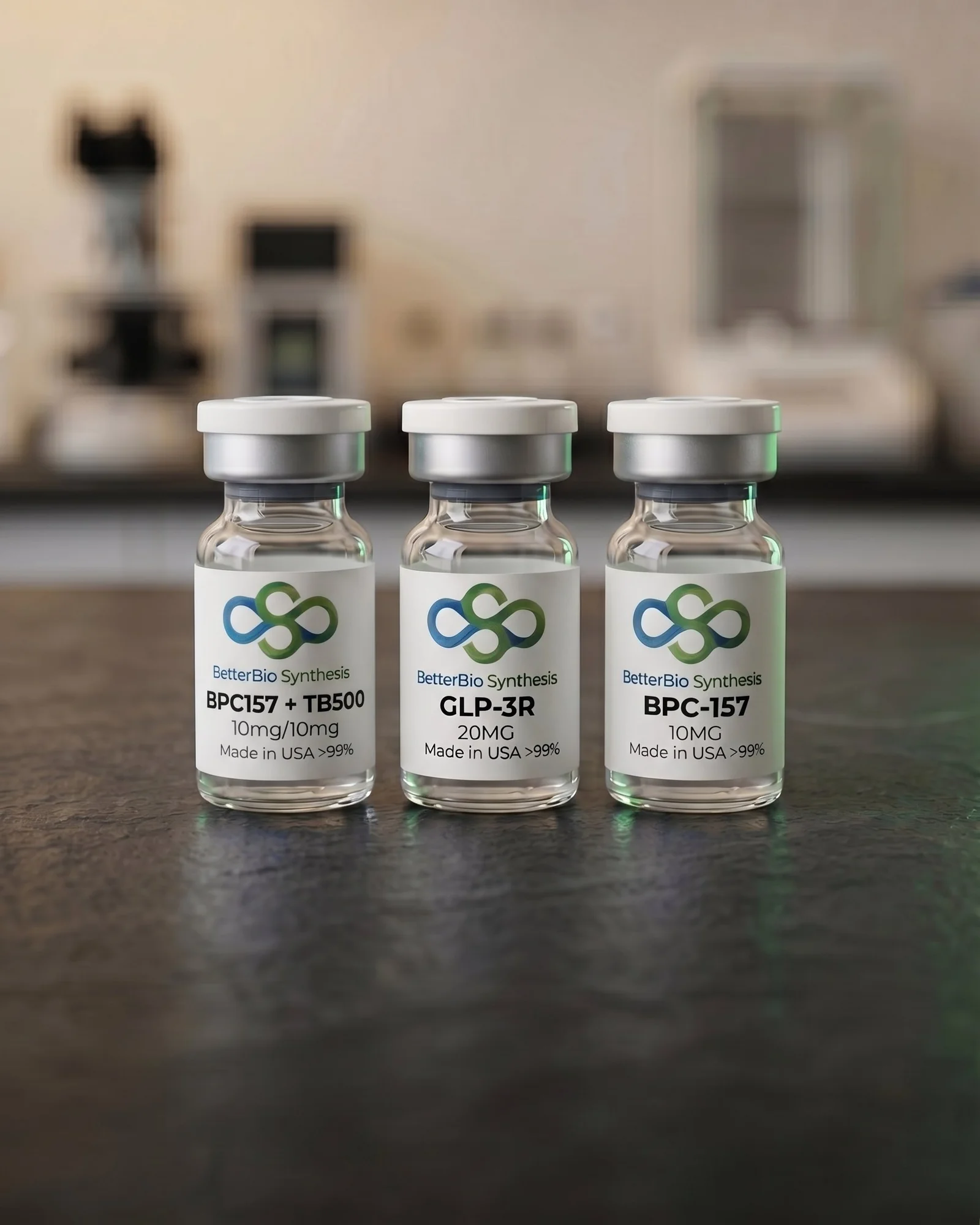
Understand how HPLC, Mass Spec, and LC-MS answer different peptide COA questions so research batches can be evaluated beyond a single purity number.
COA Literacy
HPLC
LC-MS
A clean peptide COA should answer two different questions: how pure does the batch appear under the method, and does the main material match the identity on the label?
Research Use Only
BetterBio Synthesis materials are sold for Research Use Only (RUO). They are not intended for human consumption, clinical use, diagnosis, treatment, prevention, or cure of any disease. This article is educational content about analytical testing and research documentation. It is not medical advice, dosing guidance, or a recommendation for human use. Not evaluated by the FDA. Must be 21+.
Quick Read: Purity vs Identity
HPLC helps estimate chromatographic purity under a specific method. Mass Spec helps confirm that the main material has the expected molecular signature.
LC-MS brings those signals together, making it more useful for evaluating peptide COAs than a single purity number by itself.
What a Strong COA Should Help Verify
- Batch identity and traceability
- Chromatographic purity
- Molecular identity confirmation
- Relevant contamination and handling risks
A peptide Certificate of Analysis can look scientific while still leaving important questions unanswered. The most common example is the phrase "greater than 99% purity." That number matters, but it does not prove everything many readers assume it proves.
In peptide quality control, purity and identity are related but separate questions. HPLC is commonly used to estimate chromatographic purity. Mass spectrometry is commonly used to confirm molecular identity. LC-MS brings both ideas together by connecting chromatographic separation with mass detection.
The difference matters because synthetic peptides are built one amino acid at a time. Coupling, cleavage, purification, drying, storage, and handling can all introduce uncertainty. A strong COA should help answer whether the batch matches the label and how much unrelated material appears to be present.
HPLC Answers the Purity Question
High-performance liquid chromatography separates compounds as they move through a column. In a typical peptide purity method, the target peptide and related impurities travel at different rates based on properties such as hydrophobicity, charge, size, and interaction with the stationary phase.
When a COA reports HPLC purity, it is usually reporting the area of the main peak compared with total detected peak area under that method. A clean chromatogram with one dominant peak is a good sign. It suggests that, under the chosen conditions, most detectable material behaves like one primary component.
But HPLC is method-dependent. A different column, gradient, mobile phase, wavelength, temperature, run time, or sample preparation can change what is resolved. Two closely related peptide species can co-elute, meaning they appear under the same peak even though they are not the same molecule.
Mass Spec Answers the Identity Question
Mass spectrometry asks a different question: does the measured mass match the expected molecule? Peptides have predictable molecular masses based on their amino acid sequences and chemical modifications.
That is why Mass Spec is so important for identity confirmation. A sample can show a clean HPLC peak and still be the wrong peptide, a modified peptide, or a closely related sequence. Mass Spec helps verify that the primary material has the expected molecular signature.
Mass Spec alone is not a complete purity test. A sample could contain the correct molecule plus impurities that are not fully quantified by a simple mass readout. That is why identity and purity belong together.
Why LC-MS Is Stronger Than Either Signal Alone
LC-MS links liquid chromatography to mass spectrometry. The chromatography separates the sample over time, and the mass spectrometer evaluates molecular mass as components elute.
That pairing is especially useful for peptide research materials because related impurities can be structurally similar to the target peptide. A deletion sequence may be missing one amino acid. A truncated sequence may stop short. An oxidized form may differ by a small mass shift.
A strong LC-MS workflow gives the analyst both retention behavior and mass information, improving confidence in identification and impurity profiling.
What Greater Than 99% Purity Does Not Prove
A high HPLC purity number does not automatically prove that a batch is suitable for every research design. It does not prove identity unless identity testing is also shown. It does not prove sterility. It does not prove endotoxin status. It does not prove residual solvent control.
It also does not prove that the sample has been stored correctly after testing, or that the COA belongs to the exact vial or batch in front of the researcher.
That is why COA literacy matters. A real COA is not just a marketing sheet. It is a traceability document.
The COA Questions Researchers Should Ask
A useful peptide COA should help a researcher evaluate the batch without relying on trust alone.
- Does the COA identify the exact compound, sequence, batch number, and test date?
- Does it include HPLC purity data, ideally with a chromatogram?
- Does it include Mass Spec or LC-MS identity confirmation?
- Are endotoxins, residual solvents, water content, counterions, or storage notes addressed where relevant?
- Can the document be verified independently through a real lab record or QR verification path?
Why Orthogonal Testing Is the Standard Mindset
Analytical scientists often use the word orthogonal to describe methods that approach a sample from different angles. The goal is not to repeat the same question. The goal is to reduce blind spots.
HPLC separates and estimates relative peak area. Mass Spec checks molecular mass. Endotoxin testing evaluates bacterial lipopolysaccharide contamination. Residual solvent testing looks for manufacturing solvents. Stability studies ask what happens over time under defined storage conditions.
No single test is fit for every purpose. A defensible batch record is built from multiple pieces of evidence that agree with each other.
Bottom Line
HPLC and LC-MS are not competing buzzwords. They answer different parts of the peptide quality question.
HPLC helps evaluate chromatographic purity. Mass Spec helps confirm molecular identity. LC-MS gives a more complete picture by connecting separation behavior with mass information. For Research Use Only materials, this kind of testing literacy helps separate real analytical evidence from surface-level claims.