
Why Oral Peptides Are Hard to Deliver: The Barriers Before Circulation
Learn why stomach acid, enzymes, mucus, intestinal permeability and first-pass metabolism can limit oral peptide bioavailability—and why 99% is not universal.
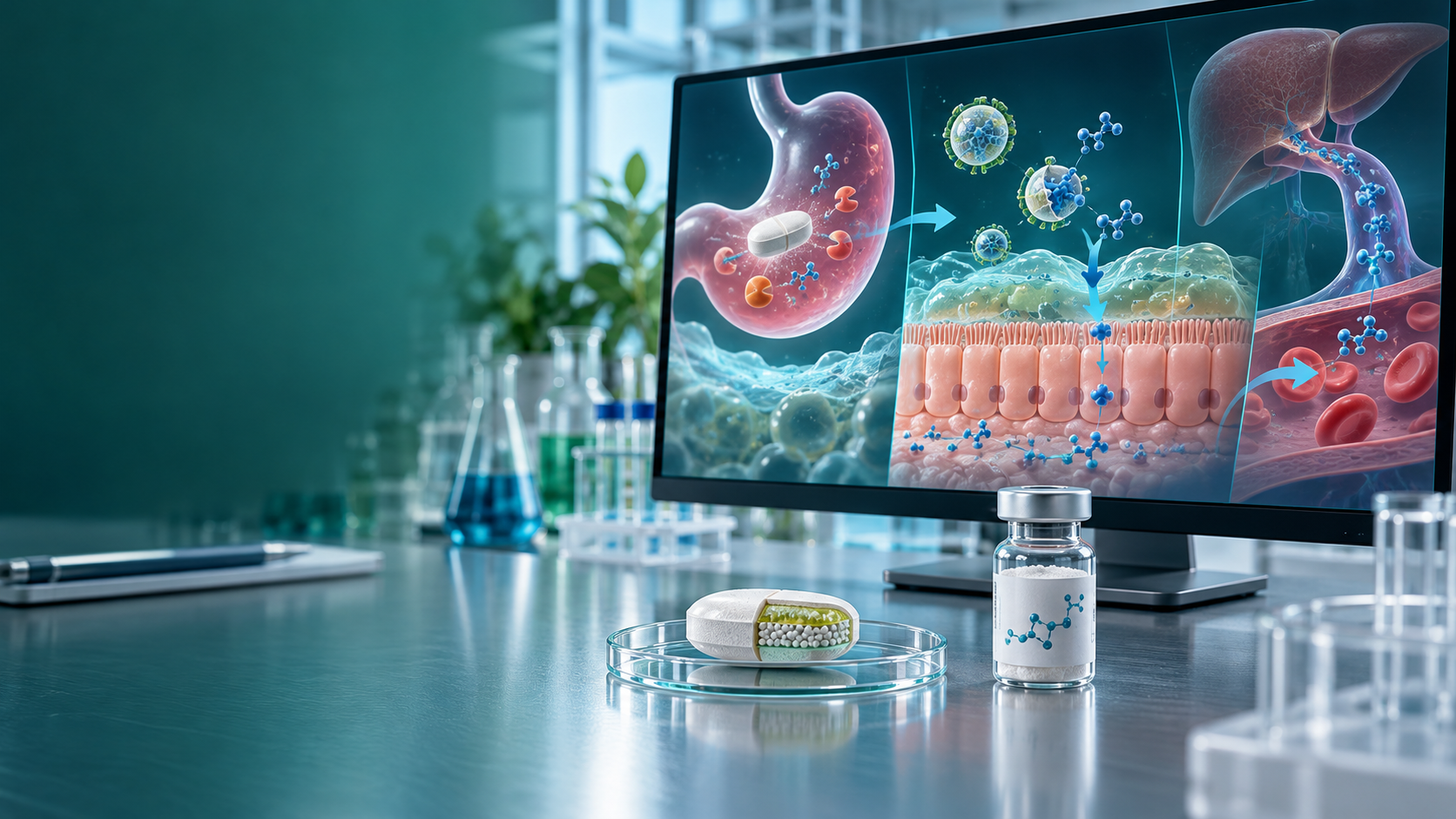
Before an intact peptide can reach systemic circulation after being swallowed, it may face stomach acid, digestive enzymes, mucus, limited movement across the intestinal lining, transport back into the gut, metabolism within the intestinal wall, and hepatic first-pass metabolism.
That sequence helps explain why many peptides have low oral bioavailability. It does not justify a universal claim that every oral peptide “loses exactly 99%.” Absorption depends on the peptide, formulation, target site, gastrointestinal route, and how exposure is measured.
Oral peptide delivery is not one problem with one solution. It is a chain of barriers, and a successful platform must address the barriers that matter for a particular molecule without creating unacceptable new risks.
What oral bioavailability actually measures
Bioavailability describes the fraction of an administered dose that reaches systemic circulation in an active or measurable form. Absolute oral bioavailability is commonly estimated by comparing systemic exposure after oral administration with an intravenous reference, with dose differences accounted for.
A known mass of peptide may be swallowed, yet only part may dissolve, survive, cross an absorptive surface, avoid presystemic metabolism, and remain intact long enough to be measured.
Bioavailability is not the same as potency, efficacy, or total material detected. A potent peptide may produce useful exposure at a low absorbed fraction, while peptide-related material in a test does not necessarily prove intact active peptide entered circulation.
Systemic bioavailability is not the endpoint for every oral peptide. Some are designed to act locally in the gastrointestinal tract, where low blood exposure may be intentional.
Stomach acid is only the first barrier
The stomach exposes swallowed material to a strongly acidic, dynamic environment. Acid can alter peptide conformation, promote hydrolysis for susceptible sequences, and affect formulation components.
Pepsin and gastric residence add an enzymatic and time-dependent barrier. Degradation depends on sequence, structure, aggregation state, meal conditions, and dosage-form behavior.
An acid-resistant or enteric coating can delay release until a less acidic region. That may protect a peptide from the stomach, but it does not solve intestinal enzymes, mucus, epithelial permeability, or presystemic metabolism. Protection from one barrier is not proof of oral bioavailability.
Digestive enzymes continue beyond the stomach
The small intestine contains pancreatic proteases and brush-border peptidases that break peptides into fragments and amino acids. Those enzymes serve normal nutrition but work against delivery of an intact peptide.
Sequence and structure influence susceptibility. Cyclization, terminal modifications, non-natural amino acids, steric shielding, and other changes may increase stability, but can also alter receptor binding, solubility, manufacturing, or immunogenicity.
Enzyme inhibitors are also being studied. Their effect must be localized and controlled because digestive enzymes have physiological functions. Increased exposure cannot be evaluated separately from safety, selectivity, reversibility, and variability.
Mucus and the intestinal lining restrict movement
Surviving in the intestinal lumen is not the same as crossing into the body. A peptide must move through mucus and reach the epithelial surface.
Mucus can trap or slow large, charged, adhesive, or hydrophobic molecules. The epithelial layer creates another selective barrier because peptides are generally larger and more polar than conventional orally absorbed small molecules.
Transcellular transport passes through epithelial cells. Paracellular transport uses narrow spaces between cells regulated by tight junctions. Strategies that increase either route must preserve the protective function of the intestinal barrier.
The intestine is a living interface designed to absorb nutrients while limiting entry of pathogens, toxins, and antigens—not simply a wall to be opened.
Crossing the lining is not the final step
Material that crosses the epithelium may still encounter metabolism within intestinal cells, transporters that move compounds back toward the lumen, and portal circulation leading to the liver.
The intestinal wall and liver can contribute to first-pass loss before a compound reaches broader systemic circulation. Their relevance varies by peptide and formulation.
Researchers therefore measure maximum concentration, time to maximum concentration, and area under the concentration-time curve. Assay design matters: a method measuring total immunoreactive material may not distinguish intact peptide from fragments.
Why “every peptide loses 99%” is inaccurate
Many unformulated peptides have extremely low oral systemic bioavailability, and values below 1% are often described as typical. That warns researchers about the scale of the challenge; it is not a universal constant.
Peptides differ in length, charge, hydrophobicity, conformation, protease susceptibility, aggregation, potency, and metabolic stability. Formulations differ in release site, coatings, enhancers, carriers, enzyme protection, residence time, and manufacturing performance.
Gastric emptying, intestinal transit, food, fluid volume, pH, motility, mucus, microbiota, inflammation, and disease state add physiological variability.
The absorbed fraction must be measured for the specific compound and formulation rather than assigned from a slogan.
How researchers are approaching the barrier chain
Protective coatings can control release location. Local pH modifiers may improve stability. Protease inhibitors may reduce breakdown near the dosage form. Permeation enhancers may transiently support epithelial transport.
Mucoadhesive systems seek longer surface contact, while mucus-penetrating systems try to avoid entrapment. Lipid systems, nanoparticles, hydrogels, and other carriers may protect cargo or concentrate it near an absorptive surface.
Cyclization, lipidation, N-methylation, terminal modification, prodrug design, and non-natural residues may improve stability or permeability, but the modified molecule requires its own activity and safety evidence. Ingestible devices may bypass some luminal barriers while introducing mechanical and manufacturing questions.
No platform transfers automatically. A technology that improves one peptide may fail for another because stability, required dose, potency, and absorption site differ. Each final product needs direct evidence for identity, release, pharmacokinetics, safety, variability, and exposure-response.
The Responsible Takeaway
Oral peptide delivery is difficult because several barriers act in sequence. A peptide may degrade before absorption, become trapped in mucus, cross epithelial cells poorly, be transported back toward the lumen, or be metabolized before reaching systemic circulation.
Many peptides therefore show low oral bioavailability. But there is no universal rule that exactly 99% is lost, and low systemic exposure is not automatically a failure when the intended target is local to the gastrointestinal tract.
Absorption enhancers, protective coatings, enzyme-control strategies, structural modifications, carriers, and specialized devices are all being explored. None is a universal shortcut.
The research question is not simply whether a peptide is labeled “oral.” It is whether a defined compound in a defined formulation produces verified intact exposure at the intended site, with acceptable safety and reproducibility.

