
How Oral Semaglutide Gets Absorbed: SNAC and the Stomach Barrier
Learn how SNAC helps oral semaglutide survive the stomach, cross the gastric lining, and why formulation conditions affect its low absorption.
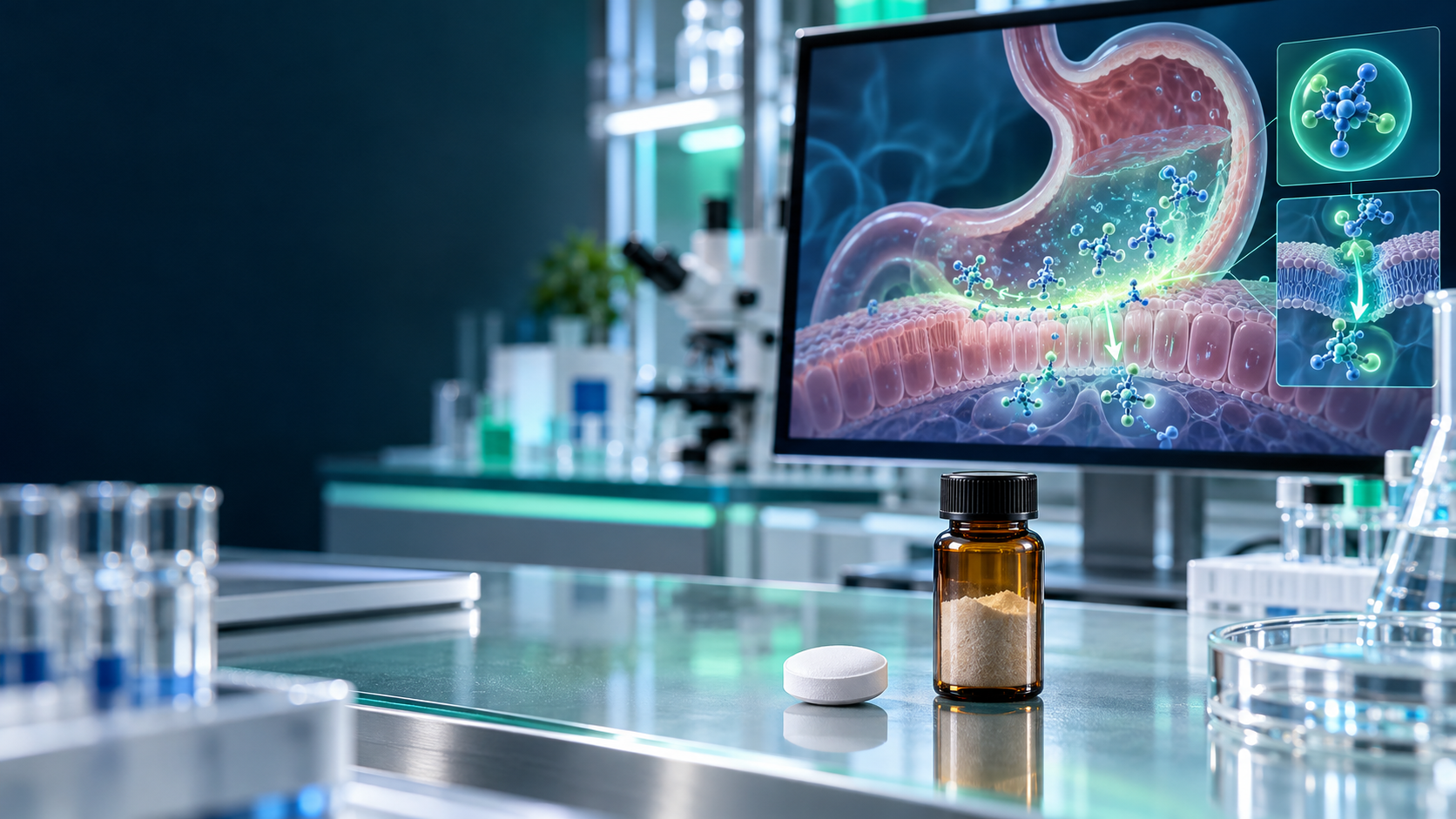
Oral semaglutide demonstrates something formulation scientists have worked toward for decades: a peptide can sometimes be delivered through the digestive system when the dosage form is engineered around the barriers that normally prevent absorption.
The tablet does not make those barriers disappear. It combines semaglutide with salcaprozate sodium, commonly called SNAC, to create a brief and highly localized environment near the tablet as it erodes in the stomach.
Only a small fraction of the swallowed semaglutide reaches systemic circulation. That does not mean the formulation is ineffective. It means the formulation, gastric environment, and conditions studied in clinical pharmacology are inseparable from the exposure the tablet produces.
Why peptides are difficult to deliver by mouth
Semaglutide is a peptide. Like other peptides, it faces two major obstacles in the digestive tract.
The first is chemical and enzymatic degradation. The stomach is acidic, and digestive enzymes are designed to break protein-like molecules into smaller components. A peptide can lose structural integrity before enough intact material reaches an absorptive surface.
The second is permeability. Peptides are comparatively large, polar molecules that do not move easily through the lipid-rich membranes of epithelial cells. Even intact peptide in the gastrointestinal tract may cross into circulation poorly.
Traditional tablets work well for many small molecules because those compounds tolerate the digestive environment and cross intestinal membranes efficiently. Oral peptide delivery asks whether a dosage form can protect the molecule and create a short window in which absorption becomes possible.
What SNAC is doing
SNAC is not merely an inert filler or a simple outer coating. It is co-formulated with semaglutide so both are released together as the tablet erodes.
Mechanistic work describes several connected local effects. SNAC buffers the microenvironment immediately around the tablet, raising local pH and reducing acid- and enzyme-driven degradation. It also reduces semaglutide oligomerization, helping keep more peptide in a molecular state compatible with absorption.
At the gastric epithelial surface, SNAC interacts with cell membranes and temporarily increases transcellular permeability. Transcellular means movement through epithelial cells rather than between them. Published studies did not find evidence that the formulation worked by opening tight junctions between cells.
These effects depend on proximity and are described as transient and localized, not as a permanent change to the entire gastrointestinal tract.
Why the stomach is the main absorption site
Most conventional oral drugs are discussed primarily in terms of intestinal absorption. Oral semaglutide is unusual because the evidence points to the stomach as the predominant absorption site.
Clinical imaging work followed radiolabeled tablets and found that complete tablet erosion occurred in the stomach. Pharmacokinetic findings, preclinical localization work, and mechanistic experiments also support absorption near the tablet surface in the gastric environment.
This helps explain why the formulation cannot be understood as semaglutide placed into an ordinary tablet. Tablet erosion, local SNAC concentration, contact with the gastric epithelium, and surrounding fluid are parts of one delivery system.
The active peptide matters, but so do the enhancer, tablet composition, release pattern, and anatomy of the absorption site.
Low bioavailability can still produce useful exposure
The January 2026 US prescribing information estimates absolute bioavailability at approximately 0.4% to 1% for the listed Rybelsus tablet strengths and approximately 1% to 2% for the listed Ozempic tablet strengths. These are formulation-specific estimates, not a statement that every person absorbs the same amount on every occasion.
Pharmacology does not require most of an oral dose to enter circulation. It requires an exposure profile that is sufficiently characterized, reproducible at the population level, and connected to the studied effect and safety profile. A potent molecule may produce useful exposure even when absolute bioavailability is low.
Semaglutide also has a long elimination half-life, which helps smooth some day-to-day absorption variability once steady state is reached. Low bioavailability and variable absorption remain important properties, but they do not automatically imply absent biological activity.
Why food, fluid volume, and timing affect exposure
Food, fluid volume, and timing can change the local conditions that SNAC and semaglutide need to establish near the stomach lining.
Food may interfere with tablet contact, alter gastric emptying, change fluid composition, or dilute the localized concentration gradient. A larger fluid volume can change tablet erosion and dilute semaglutide and SNAC around the dosage form. The interval before additional stomach contents arrive can influence the period available for localized absorption.
Clinical pharmacology studies evaluated these variables, and the FDA-approved prescribing information contains administration conditions based on that work. Those conditions are not arbitrary lifestyle details. They are part of the tested delivery system.
This article does not reproduce those directions as personal guidance. Anyone prescribed an oral semaglutide product should rely on the current product labeling and their licensed clinician or pharmacist.
Exposure is not the same as dose
The amount printed on a tablet is the administered dose. Exposure describes how much drug reaches circulation over time, often summarized with pharmacokinetic measures such as area under the curve and maximum concentration.
Two oral formulations containing different nominal amounts cannot be assumed to produce proportional or interchangeable exposure. The 2026 prescribing information states that the listed semaglutide tablet products are not substitutable on a milligram-for-milligram basis.
This is a broader research-literacy lesson. Milligrams describe mass. They do not, by themselves, describe bioavailability, absorption rate, systemic exposure, receptor engagement, or clinical effect. Formulation can change the relationship between all of those layers.
What the research does not prove
The oral semaglutide platform does not establish that any peptide can become an effective tablet by adding SNAC. Absorption enhancement is molecule-specific. Peptide size, structure, stability, aggregation, potency, required exposure, and interaction with the enhancer all matter.
The research also does not support informal reformulation, altering tablets, combining a peptide with a separate enhancer, or treating administration conditions as optional. A commercial dosage form reflects extensive work on co-formulation, manufacturing, stability, pharmacokinetics, and clinical performance.
Low bioavailability should not be used to compare oral and injectable products by simple arithmetic. Route, formulation, exposure, and labeled use must be evaluated together.
The Responsible Takeaway
Oral semaglutide shows how pharmaceutical formulation can work with a difficult biological barrier rather than pretending the barrier is absent.
SNAC creates a localized gastric microenvironment that helps protect semaglutide from degradation, limits oligomerization, and temporarily supports transcellular absorption across the stomach lining. Imaging and pharmacokinetic studies show that tablet erosion and absorption are centered in the stomach.
Only a small fraction of the swallowed peptide is absorbed, and exposure is sensitive to conditions around tablet erosion. That does not mean the product lacks effect. It means the formulation and its studied conditions are essential parts of how the product works.
The broader lesson reaches beyond one drug: for oral peptide delivery, the active molecule is only one part of the technology. The enhancer, dosage form, release site, local chemistry, and pharmacokinetic design all help determine whether a peptide can cross from a tablet into circulation.

