
The Gut Health Research Stack: BPC-157, KPV, Thymosin Alpha-1 & GLP-2
Research guide to the Gut Health Stack — BPC-157, KPV, Thymosin Alpha-1, and GLP-2. Four systems, one protocol. For Research Use Only.
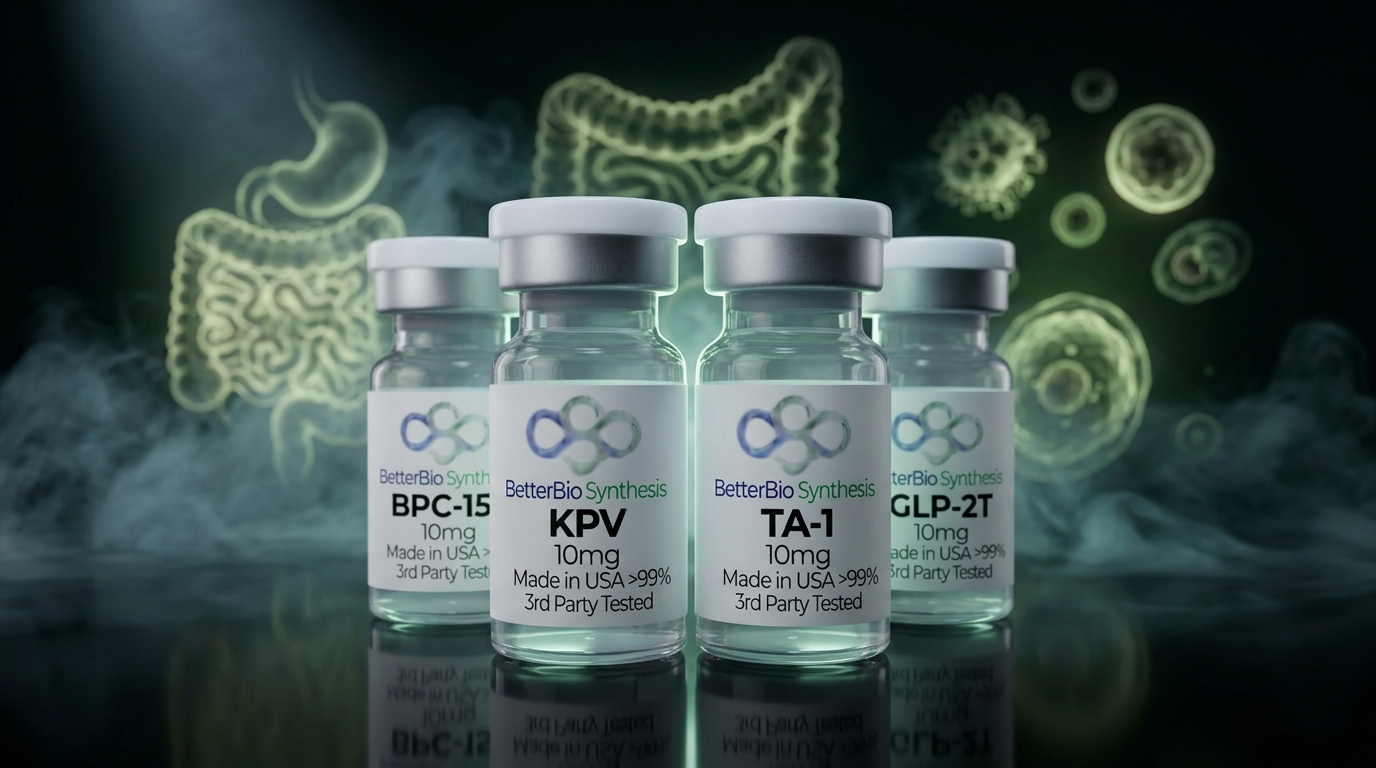
What Is the Gut Health Research Stack?
The Gut Health Research Stack is a multi-peptide research protocol targeting intestinal health through four distinct biological mechanisms simultaneously.
The stack consists of:
• BPC-157 — Mucosal repair, tight junction restoration, cytoprotection
• KPV — NF-kB inflammatory cascade suppression
• Thymosin Alpha-1 (TA-1) — Immune modulation at the T-cell level
• GLP-2 (Trez) — Intestinal epithelial regeneration and growth
Each peptide in this stack operates through a different mechanism, addressing a different aspect of gut barrier dysfunction and intestinal inflammation. Together they represent one of the most comprehensive multi-mechanism gut research protocols currently being studied.
⚠️ All peptides are for Research Use Only (RUO). Not for human consumption. Not medical advice. Not FDA evaluated. Must be 21+.
Understanding Leaky Gut and Intestinal Permeability
Before understanding how these peptides work, it helps to understand the problem they are being studied for.
The Gut Barrier
The intestinal lining is a single cell layer thick — one of the most remarkable barriers in human biology. Tight junction proteins (claudin, occludin, ZO-1) hold these epithelial cells together, forming a selective barrier that allows nutrients through while blocking pathogens, undigested food particles, and bacterial endotoxins.
When the Barrier Breaks Down
When tight junctions weaken or open inappropriately — from chronic inflammation, autoimmune conditions, NSAIDs, alcohol, infections, or dietary triggers — the barrier becomes permeable. This is what researchers refer to as increased intestinal permeability or leaky gut.
Material that should remain in the intestinal lumen crosses into systemic circulation. The immune system recognizes this leaked material as foreign and mounts an inflammatory response. Chronic intestinal permeability creates chronic systemic inflammation.
The Four Systems the Stack Addresses
• Structural damage to the mucosal lining — BPC-157
• The inflammatory cascade driving ongoing damage — KPV
• The immune dysregulation downstream of barrier breakdown — Thymosin Alpha-1
• Regeneration of intestinal epithelial cells — GLP-2
This is why a multi-peptide approach is increasingly being explored in gut health research — each system requires a different intervention.
BPC-157 — Mucosal Repair and Tight Junction Restoration
BPC-157 is the foundation of the Gut Health Research Stack — and its origin makes it uniquely suited for this role.
BPC-157 is derived from a protective protein naturally found in human gastric juice. The stomach produces this protein to protect itself from acid damage. Researchers isolated and synthesized the most biologically active fragment — a 15-amino-acid sequence now known as BPC-157.
Why BPC-157 Is Different for Gut Research
Unlike most peptides that degrade in gastric acid, BPC-157 demonstrates exceptional stability in acidic environments. This makes oral administration a viable research route for GI applications — allowing the peptide to reach the intestinal mucosa directly.
Key Gut Research Findings
• Restoration of tight junction proteins (claudin, occludin, ZO-1) in leaky gut models
• Reversal of NSAID-induced intestinal damage and ulceration
• Reduction of inflammatory markers in IBD models
• Healing of intestinal fistulas and surgical anastomosis sites
• Cytoprotective effects across the entire GI tract from esophagus to colon
• Promotion of new blood vessel formation (angiogenesis) in damaged mucosal tissue
Mechanism in the Stack
BPC-157 addresses the structural component — rebuilding the physical integrity of the mucosal lining. It is the repair mechanism of the stack.
CAS: 137525-51-0 | MW: 1,419.5 g/mol
⚠️ For Research Use Only.
KPV — Shutting Down the Inflammatory Cascade
KPV (Lysine-Proline-Valine) is a tripeptide fragment derived from alpha-melanocyte stimulating hormone (α-MSH). At just three amino acids, it is one of the smallest peptides in current gut research — and its small size is actually a significant advantage.
The NF-kB Mechanism
KPV works primarily through inhibition of NF-kB (nuclear factor kappa B) — the master transcription factor that controls inflammatory gene expression in intestinal epithelial cells.
When NF-kB is activated in gut tissue it drives production of TNF-α, IL-6, IL-8, and IL-1β — the cytokines that sustain intestinal inflammation, perpetuate tight junction breakdown, and drive the cycle of ongoing mucosal damage.
KPV enters intestinal epithelial cells via the PepT1 transporter and directly blocks NF-kB nuclear translocation — preventing the inflammatory signal from activating inflammatory genes at the source.
Key Research Findings
• Reduced colonic inflammation in DSS and TNBS-induced colitis mouse models
• Decreased pro-inflammatory cytokine expression across multiple IBD models
• Attenuation of disease severity scores in colitis research
• PepT1-mediated uptake confirmed — the same transporter that is upregulated during intestinal inflammation, meaning KPV delivery is enhanced precisely when and where it is most needed
Mechanism in the Stack
KPV addresses the inflammatory driver — suppressing the cytokine cascade that causes and perpetuates gut barrier damage. Where BPC-157 rebuilds the structure, KPV stops the fire.
CAS: 63631-40-3 | MW: 342.4 g/mol
⚠️ For Research Use Only. Note: KPV is subject to ongoing FDA regulatory review. Monitor current status.
Thymosin Alpha-1 — Immune Modulation
Thymosin Alpha-1 (TA-1) is a 28-amino-acid peptide derived from thymosin fraction 5, a thymic peptide preparation first isolated in the 1970s by Dr. Allan Goldstein. It is one of the most clinically studied peptides in immunology research.
Why Immune Modulation Matters for Gut Health
When intestinal permeability allows bacterial endotoxins and undigested antigens to cross into systemic circulation, the immune system mounts a response. In susceptible individuals — particularly those with autoimmune conditions like Celiac disease, IBD, or food sensitivities — this immune activation can become dysregulated, perpetuating systemic inflammation far beyond the gut itself.
Thymosin Alpha-1 addresses this downstream immune dysregulation.
Mechanism of Action
TA-1 modulates T-cell function and dendritic cell activity, shifting the immune response from inflammatory (Th1/Th17 dominant) toward regulatory (Treg dominant) patterns. This immune rebalancing is relevant to conditions where an overactive immune response is driving pathology.
Key Research Findings
• Approved as Zadaxin in over 35 countries for hepatitis B, hepatitis C, and as an immune adjuvant
• Modulates both innate and adaptive immune responses
• Enhances T-regulatory cell activity — the immune cells that prevent excessive inflammatory responses
• Research in autoimmune models has demonstrated reduction in autoantibody production
• Anti-inflammatory activity in models of chronic inflammatory disease
Mechanism in the Stack
Thymosin Alpha-1 addresses the immune component — normalizing the overactive immune response triggered by intestinal permeability. It is the immune regulator of the stack.
CAS: 62304-98-7 | MW: 3,108.4 g/mol
⚠️ For Research Use Only.
GLP-2 (Trez) — Intestinal Regeneration
GLP-2 (Glucagon-Like Peptide-2) is an endogenous peptide produced naturally by L-cells in the intestinal lining in response to food intake. It is the most directly targeted peptide in the stack for intestinal epithelial regeneration.
Why GLP-2 Is Unique in Gut Research
Unlike the other peptides in the stack which are primarily anti-inflammatory or cytoprotective, GLP-2 is a direct intestinal growth factor. It specifically promotes the proliferation and survival of intestinal epithelial cells — the cells that form the gut lining itself.
A synthetic analog of GLP-2 (teduglutide, brand name Gattex) is FDA approved for Short Bowel Syndrome — making GLP-2 one of the few gut peptide mechanisms with direct regulatory validation for intestinal repair.
Mechanism of Action
• Stimulates intestinal crypt cell proliferation — increasing the production of new epithelial cells
• Inhibits enterocyte apoptosis (programmed cell death) — protecting existing gut lining cells
• Promotes intestinal villous growth — increasing the surface area of the gut lining
• Reduces intestinal permeability through mucosal thickening and barrier reinforcement
• Stimulates blood flow to the intestinal mucosa via vasoactive intestinal peptide pathways
Key Research Findings
• FDA-approved analog teduglutide demonstrates significant intestinal mucosal growth in Short Bowel Syndrome
• Preclinical research shows GLP-2 increases villous height and crypt depth in models of intestinal atrophy
• Reduces intestinal permeability markers in research models
• Protective effects in models of chemotherapy-induced mucositis
Mechanism in the Stack
GLP-2 addresses regeneration — actively growing new intestinal lining cells to replace those damaged by chronic inflammation and permeability. It is the rebuilding mechanism of the stack.
⚠️ For Research Use Only.
Why These Four Peptides Work Together
The Gut Health Research Stack is built on a simple principle: each peptide addresses a different mechanism of gut dysfunction that the others cannot.
The Four Mechanisms
→ BPC-157 — Structural mucosal repair and tight junction restoration
Addresses the physical damage to the gut lining. Rebuilds the barrier from the inside out.
→ KPV — NF-kB inflammatory cascade suppression
Suppresses the cytokine-driven inflammation perpetuating the damage. Stops the fire.
→ Thymosin Alpha-1 — T-cell immune modulation
Normalizes the systemic immune overactivation triggered by intestinal permeability. Rebalances the immune response.
→ GLP-2 — Intestinal epithelial regeneration
Actively stimulates new intestinal lining cell growth. Rebuilds what was lost.
The Research Rationale
Chronic gut dysfunction is rarely caused by a single mechanism. Intestinal permeability, inflammatory bowel conditions, and autoimmune gut conditions typically involve simultaneous structural damage, inflammatory signaling, immune dysregulation, and impaired tissue regeneration.
A single peptide addressing only one of these systems leaves the other three unaddressed. The Gut Health Research Stack represents a four-system approach — covering structure, inflammation, immunity, and regeneration in a single coordinated protocol.
Each peptide does what the others cannot. Together they cover the full picture of gut barrier research.
Research Dosing Protocols
The following reflects dosing protocols observed in preclinical research and peer-reviewed literature. This is NOT a dosing recommendation for human use. All peptides are for Research Use Only.
BPC-157
• Oral (GI applications): 500mcg – 1000mcg daily on empty stomach
• Injectable: 250mcg – 500mcg once or twice daily
• Cycling: 4-6 weeks on, 2-4 weeks off
KPV
• Research range: 200mcg – 500mcg per administration
• Oral administration studied via PepT1 transport mechanism
• Frequency: Once or twice daily in research models
Thymosin Alpha-1
• Research range: 1.6mg – 3.2mg per administration
• Frequency: 2x weekly in most research protocols
• Route: Subcutaneous in clinical models
GLP-2
• Research range: 400mcg – 800mcg per administration
• Frequency: Once daily in research models
• Route: Subcutaneous
Storage for All Peptides
• Lyophilized powder: -20°C, stable 24+ months
• Reconstituted: 2-8°C, use within 28 days
• Protect from light and freeze-thaw cycles
• Reconstitute with bacteriostatic water
⚠️ For Research Use Only. Not for human consumption. Not medical advice.
BBS Quality Standard
At Better Bio Synthesis every peptide in the Gut Health Research Stack meets the same uncompromising standard:
✓ Manufactured in the USA by an ISO & GMP regulated facility
✓ HPLC verified for sequence accuracy
✓ Mass Spectrometry confirmed
✓ 3rd party tested by independent analytical laboratories
✓ >99% purity guaranteed
✓ Full Certificate of Analysis with every order
✓ Every supplier listed on every COA — complete supply chain transparency
✓ Ships within 48 hours
This is what Purity Without Compromise actually means.
⚠️ All peptides sold by Better Bio Synthesis are for Research Use Only (RUO). Not for human consumption. Not medical advice. Not evaluated by the FDA. Must be 21+ to purchase. betterbiosynthesis.com

