The Wolverine Stack: BPC-157 + TB-500 Research Guide
Complete research guide to the Wolverine Stack — BPC-157 and TB-500. Mechanisms, synergy, healing cascade, dosing protocols and latest 2026 research. For Research Use Only.
What Is the Wolverine Stack?
The Wolverine Stack is the most recognized peptide combination in the recovery research community. It pairs two of the most extensively studied tissue repair peptides in preclinical science — BPC-157 and TB-500 (Thymosin Beta-4) — into a single coordinated research protocol.
The name references the Marvel character Wolverine, whose defining trait is near-instant regenerative healing. The scientific rationale behind the combination is that BPC-157 and TB-500 target overlapping but distinct biological pathways, producing effects that neither compound achieves alone.
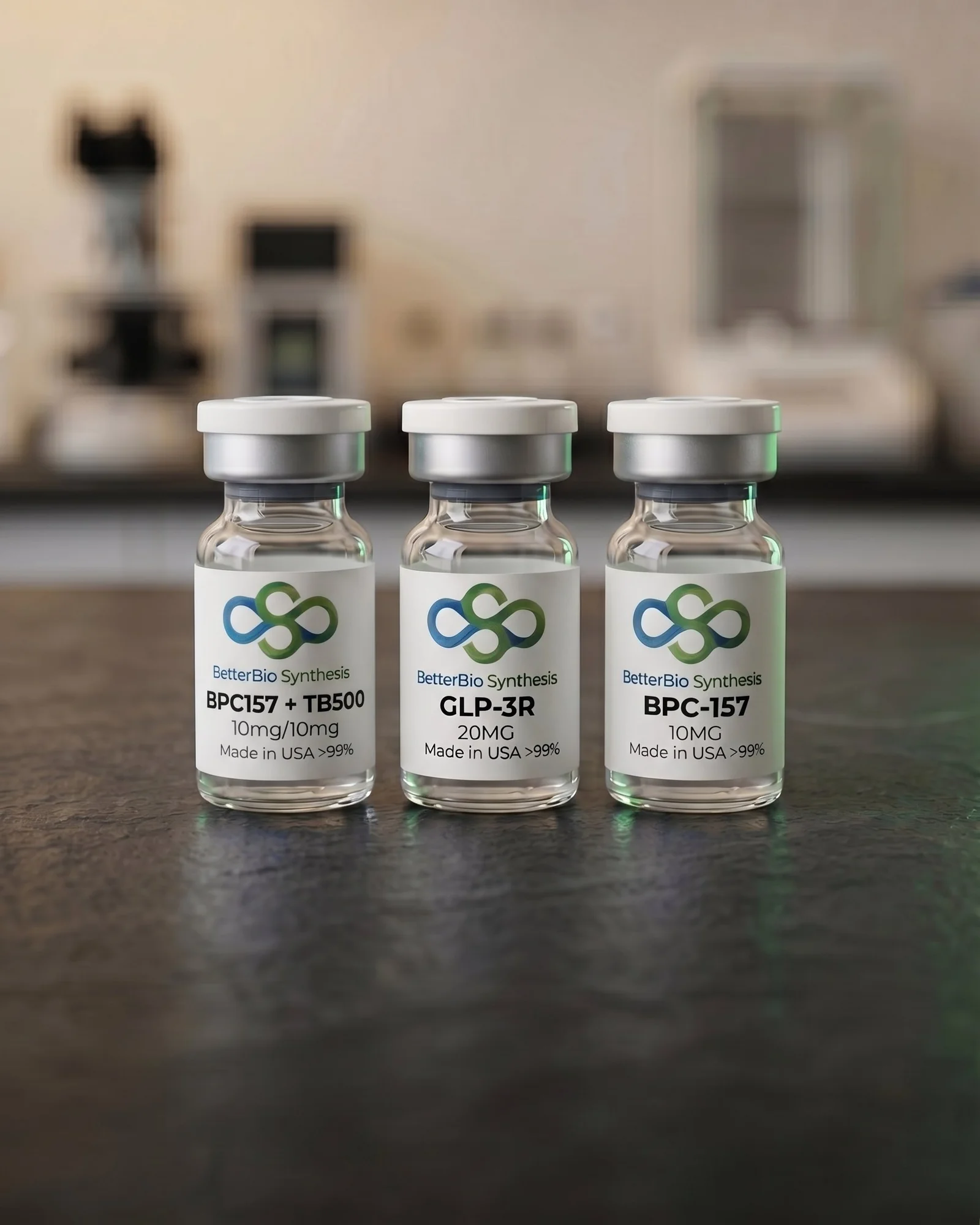
At Better Bio Synthesis the Wolverine Stack is available as a pre-blended formulation:
BPC-157 + TB-500 Blend
• BPC-157: 10mg
• TB-500 (Thymosin Beta-4): 10mg
• Total: 20mg blend
• Manufactured in the USA
• >99% purity, HPLC and Mass Spec verified
• 3rd party tested, full COA included
Why a blend?
Blending both peptides into a single vial simplifies research protocols, ensures consistent ratio delivery, and reduces the number of reconstitutions required. Both peptides are compatible in solution and stable when properly stored.
⚠️ All peptides are for Research Use Only (RUO). Not for human consumption. Not medical advice. Not FDA evaluated. Must be 21+.
The Science Behind Why They Work Together
BPC-157 and TB-500 do not simply overlap — they operate through distinct biological pathways that converge on the same outcome: accelerated tissue repair. Understanding why the combination is considered synergistic requires understanding what each peptide does independently.
BPC-157 — Local Repair Specialist
BPC-157 is a gastric-derived pentadecapeptide (15 amino acids) that operates primarily at the local level — near the site of administration. Its primary mechanisms include:
• VEGF upregulation — stimulating new blood vessel formation at the injury site
• Growth hormone receptor upregulation in tendon fibroblasts
• Nitric oxide pathway modulation — improving local blood flow
• NF-kB downregulation — reducing inflammatory signaling
• Direct cytoprotective effects on local tissue cells
BPC-157 is the precision instrument of the stack — it drives intense local repair activity at the specific site where it is administered.
TB-500 — Systemic Recovery Specialist
TB-500 is a synthetic fragment of Thymosin Beta-4 that operates systemically — throughout the entire body after administration. Its primary mechanisms include:
• Actin regulation — promoting cell migration to injury sites throughout the body
• Systemic angiogenesis — new blood vessel formation across multiple tissue types
• Anti-fibrotic activity — reducing scar tissue formation
• Downregulation of pro-inflammatory cytokines including IL-6 and TNF-alpha
• Cardiac progenitor cell activation — unique to TB-500 among recovery peptides
TB-500 is the systemic amplifier of the stack — it mobilizes repair resources throughout the entire body, not just at one location.
The Synergistic Mechanism
As leading researchers have described it: TB-500's systemic cell migration effects create a circulating pool of repair-competent cells, while BPC-157's local growth factor upregulation provides the signaling environment those cells need to engage productively at the injury site.
In other words — TB-500 sends the repair cells, BPC-157 tells them exactly where to go and what to do when they get there.
Both peptides demonstrate convergent effects on angiogenesis promotion and inflammatory modulation while maintaining distinct molecular targets and cellular mechanisms, suggesting synergistic applications in regenerative research contexts.
The Healing Cascade — How the Stack Works Phase by Phase
One of the most compelling aspects of the Wolverine Stack is how the two peptides address different phases of the tissue repair cascade simultaneously.
Phase 1 — Inflammation (Days 1-5)
In the inflammatory phase the body sends immune cells to the injury site, increases blood flow, and begins clearing damaged tissue. This phase is necessary but can become counterproductive if prolonged.
• TB-500 suppresses the inflammatory cytokine response — reducing excess inflammation that slows healing
• BPC-157 begins upregulating growth factors — preparing the repair environment
• Both peptides promote angiogenesis — establishing new blood supply to the injury site
Phase 2 — Proliferation (Days 5-21)
In the proliferative phase new tissue cells are generated, collagen is deposited, and the structural framework of repair is built.
• BPC-157 drives intense local proliferative activity — growth factor signaling, fibroblast activation, new vessel maturation
• TB-500 promotes cell migration — bringing additional repair-competent cells from throughout the body to the injury site
• Together they accelerate collagen deposition and tissue matrix reconstruction
Phase 3 — Remodeling (Weeks 3-12+)
In the remodeling phase newly formed tissue matures, collagen fibers align, and tensile strength is restored.
• TB-500's anti-fibrotic activity reduces excessive scar tissue formation — promoting functional tissue over non-functional scar
• BPC-157's sustained angiogenic effects maintain blood supply to the maturing tissue
• Both peptides' anti-inflammatory activity prevents chronic inflammation from disrupting the remodeling process
This phase-by-phase complementarity is why researchers have described the Wolverine Stack as covering the full healing cascade rather than just one phase of recovery.
Research Applications — What the Science Actually Shows
The Wolverine Stack has been studied across a wide range of tissue types in preclinical research. Here is what the published evidence shows for each:
Tendon and Ligament Research
This is where BPC-157 and TB-500 have the most extensive individual preclinical literature. Multiple studies have demonstrated:
• Accelerated Achilles tendon healing in rodent transection models
• Improved collagen organization and tensile strength in healing tendons
• Faster functional recovery compared to controls
• BPC-157's growth hormone receptor upregulation in tendon fibroblasts is considered a primary driver
• TB-500's cell migration promotion brings additional fibroblasts to the repair site
2025 research published in the Journal of Orthopaedic Research and Therapy specifically identified BPC-157 as an emerging compound of interest in orthopaedic sports medicine research.
Muscle Repair Research
In muscle crush injury and laceration models:
• BPC-157 accelerated muscle fiber regeneration and satellite cell activation
• TB-500 promoted systemic mobilization of muscle repair cells
• Combined preclinical data suggests faster functional recovery than either peptide alone
Bone Healing Research
• BPC-157 has demonstrated improved fracture healing with enhanced callus formation
• TB-500's angiogenic activity supports the vascular supply critical for bone repair
• Combination research suggests complementary activity in bone defect models
Gut and GI Research
This is a unique advantage of BPC-157 with no parallel in TB-500:
• BPC-157 demonstrates exceptional stability in gastric acid — unlike TB-500
• Oral BPC-157 has shown gut lining repair, tight junction restoration, and IBD model improvement
• For gut-specific research TB-500 adds systemic anti-inflammatory support
Cardiac Research
This is a unique advantage of TB-500 with no parallel in BPC-157:
• TB-500 has demonstrated cardiac progenitor cell reactivation in post-infarction models
• Reduced infarct size and improved ejection fraction in preclinical cardiac injury models
• BPC-157 contributes cardiovascular support through nitric oxide pathway modulation
Neurological Research
• TB-500 has demonstrated neurogenesis promotion and axonal outgrowth in spinal cord and TBI models
• BPC-157 has shown neuroprotective effects and peripheral nerve regeneration activity
• Combined neurological repair research is an active area of investigation
Wound Healing
• BPC-157 accelerates surface wound healing through angiogenesis and fibroblast activation
• TB-500 provides systemic repair cell mobilization
• Both peptides have demonstrated wound healing activity in multiple preclinical models
BPC-157 vs TB-500 — Key Differences
Understanding the fundamental differences between these two peptides explains why they are considered complementary rather than redundant.
Origin
• BPC-157 — Derived from a protective protein in human gastric juice
• TB-500 — Derived from Thymosin Beta-4, naturally present in virtually every cell
Mechanism
• BPC-157 — VEGF upregulation, GH receptor activation, nitric oxide modulation
• TB-500 — Actin regulation, systemic cell migration, anti-fibrotic signaling
Scope of Action
• BPC-157 — Local/regional — works primarily near the administration site
• TB-500 — Systemic — works throughout the entire body after administration
Unique Strengths
• BPC-157 — GI healing, oral bioavailability for gut applications, local precision
• TB-500 — Cardiac repair research, systemic coverage, longer half-life
Molecular Size
• BPC-157 — ~1,419 Da (smaller peptide)
• TB-500 — ~4,963 Da (larger peptide)
Half-Life
• BPC-157 — Shorter half-life, supports more frequent dosing for local applications
• TB-500 — Longer half-life, supports less frequent dosing for systemic coverage
Oral Bioavailability
• BPC-157 — Yes, for GI-specific research (exceptional gastric acid stability)
• TB-500 — Not established for oral use
Bottom Line
BPC-157 handles local precision repair. TB-500 handles systemic recovery. Neither does what the other does. That is the foundation of the Wolverine Stack's research rationale.
The Good: Research-Backed Benefits of the Stack
The Wolverine Stack has accumulated one of the most extensive bodies of preclinical evidence of any peptide combination currently being studied. Here is the evidence-based summary:
Accelerated Tissue Repair
The most consistent finding across both peptides and their combination is accelerated healing across multiple tissue types. Tendon, ligament, muscle, bone, and wound healing models have all demonstrated faster repair timelines compared to controls.
Dual Angiogenesis
Both peptides independently promote angiogenesis through different pathways — BPC-157 through VEGF and nitric oxide, TB-500 through actin-mediated cell migration and endothelial activation. The combination provides dual angiogenic stimulation — critical for delivering oxygen and nutrients to healing tissue.
Anti-Inflammatory Synergy
Both peptides independently modulate inflammation — BPC-157 through NF-kB, TB-500 through cytokine suppression. Combined anti-inflammatory coverage addresses multiple inflammatory pathways simultaneously.
Reduced Fibrosis
TB-500's anti-fibrotic activity reduces pathological scar tissue formation. BPC-157's modulation of metalloproteinases supports healthy extracellular matrix remodeling. Together they promote functional tissue over non-functional scar.
Full Cascade Coverage
As described in the healing cascade section — the combination addresses all three phases of tissue repair rather than just one, providing continuous research support throughout the recovery timeline.
Complementary Tissue Coverage
BPC-157 covers gut and GI applications that TB-500 cannot. TB-500 covers cardiac and systemic applications that BPC-157 cannot. Combined they represent the broadest tissue coverage of any two-peptide research stack.
⚠️ All research findings discussed are preclinical. Human clinical trial data is limited. For Research Use Only.
The Bad: Side Effects and Research Limitations
Transparency is core to what we do at Better Bio Synthesis. Here is what the research flags:
Known Side Effects (Preclinical and Anecdotal)
BPC-157:
• Injection site reactions — mild redness or irritation
• Nausea — occasionally reported, typically mild
• Dizziness — transient, more common with higher doses
TB-500:
• Injection site reactions — mild warmth or redness
• Fatigue — brief post-administration tiredness
• Headache — occasionally reported, typically resolves within hours
Important Research Limitations
• The overwhelming majority of research is preclinical — animal models and cell culture
• Human clinical trial data on the combination specifically is extremely limited
• Long-term safety in humans has not been established for either compound
• Optimal dosing protocols for humans are not defined by controlled trials
• The synergistic effects observed in preclinical models may not translate directly to humans
FDA Regulatory Status
Both BPC-157 and TB-500 are on the FDA's Category 2 bulk drug substance list — substances identified as presenting concerns when compounded for human use. Researchers should monitor current regulatory status of both compounds.
Cancer Consideration
Both peptides promote angiogenesis and cell growth. The theoretical concern exists that these mechanisms could support tumor growth in individuals with existing malignancy. Research in subjects with active cancer is strongly discouraged.
WADA Status
TB-500 is on the World Anti-Doping Agency prohibited list. BPC-157 is also under WADA review. Competitive athletes subject to drug testing should not use either compound.
⚠️ For Research Use Only. Not approved by the FDA for human use.
Research Dosing Protocols
The following reflects dosing protocols observed in preclinical research and peer-reviewed literature. This is NOT a dosing recommendation for human use. All peptides are for Research Use Only.
BPC-157 Research Dosing
• Injectable: 250mcg – 500mcg per administration
• Frequency: Once or twice daily in research models
• Route: Subcutaneous or intramuscular
• Oral (GI applications): 500mcg – 1000mcg daily on empty stomach
• Cycling: 4-6 weeks on, 2-4 weeks off
TB-500 Research Dosing
• Standard range: 2.0mg – 5.0mg per administration
• Frequency: 2x weekly (loading phase) → 1x weekly (maintenance)
• Route: Subcutaneous or intramuscular
• Loading phase: 4 weeks
• Maintenance phase: weeks 5-12
• Off-cycle: 4-8 weeks
Wolverine Stack Blend Dosing
The BBS Wolverine Blend contains 10mg BPC-157 and 10mg TB-500 per vial. Researchers typically administer the blend according to the TB-500 frequency protocol given its longer half-life — with the BPC-157 component providing additional local coverage at each administration.
Administration Timing
Some research protocols separate BPC-157 and TB-500 administration — for example morning and evening — to maximize the distinct activity windows of each peptide. Others administer simultaneously. No direct comparative study exists on optimal timing.
Storage
• Lyophilized powder: -20°C, stable 24+ months
• Reconstituted: 2-8°C, use within 28 days
• Protect from light and freeze-thaw cycles
• Reconstitute with bacteriostatic water
⚠️ For Research Use Only. Not for human consumption. Not medical advice.
What the Research Doesn't Know Yet
Honest science acknowledges its gaps. Here is what the Wolverine Stack research still needs to establish:
• Direct combination studies — most research studies BPC-157 and TB-500 individually. Controlled studies specifically examining the combination are limited.
• Human clinical trial data — large-scale human trials for either compound in tissue repair indications have not been completed
• Optimal ratio — whether the 1:1 ratio in the blend is optimal or whether different ratios produce superior results is not established
• Optimal timing — simultaneous vs. separated administration has not been formally compared
• Long-term human safety — no established long-term safety profile for either compound in humans
• Cancer safety — the angiogenic and proliferative mechanisms require formal oncological safety investigation
• Drug interactions — formal interaction studies have not been conducted
• FDA regulatory trajectory — Category 2 status for both compounds requires ongoing monitoring
The Wolverine Stack has arguably the strongest mechanistic rationale and preclinical evidence base of any two-peptide research combination currently being studied. The gap between preclinical promise and human clinical evidence is the honest reality that separates credible research from hype.
BBS Quality Standard — The Wolverine Blend
At Better Bio Synthesis our Wolverine Stack blend meets the same uncompromising standard as every peptide we carry:
✓ Manufactured in the USA by an ISO and GMP regulated facility
✓ HPLC verified for sequence accuracy on both BPC-157 and TB-500
✓ Mass Spectrometry confirmed
✓ 3rd party tested by independent analytical laboratories
✓ Greater than 99% purity guaranteed
✓ Full Certificate of Analysis with every order
✓ Every supplier listed on every COA — complete supply chain transparency
✓ Ships within 48 hours
✓ Pre-blended for research convenience — consistent ratio every time
This is what Purity Without Compromise actually means.
⚠️ All peptides sold by Better Bio Synthesis are for Research Use Only (RUO). Not for human consumption. Not medical advice. Not evaluated by the FDA. Must be 21+ to purchase. betterbiosynthesis.com